
37% of people now start their search with AI, not Google
For most of my career, “search” meant one thing. You had a question, you typed it into Google, you clicked a blue link. That reflex is breaking.
In a study of 500 consumers published in January 2026, 37% said they now begin a search with an AI tool instead of a search engine.
In B2B it’s further along. G2 surveyed 1,076 decision-makers in March 2026 and found that 51% start software research with an AI chatbot more often than with Google, up from 29% eleven months earlier.
That’s a 22-point swing in under a year.
If your organic traffic has been sliding and no technical audit explains it, this is a big part of the answer, and on-page tuning won’t reverse it. I’ve written before about why I underestimated how much traffic this would cost. The data since has not been kind to my original take.
Google didn’t lose share. It stopped sending clicks.
The obvious story is that Google is collapsing. It isn’t.
Google still holds about 90% of global search, and StatCounter put it at 90.46% in May 2026. That number has barely moved in three years. Anyone waiting for a market-share crash to prove the shift is real will be waiting a long time.
The share held. The click didn’t.
Google’s AI Overviews now appear in 43% of searches, up from 15% a year earlier, per Similarweb data reported in July 2026. Visits to AI Mode, the conversational tab, climbed from 126 million in June 2025 to 279 million in May 2026.
So the question gets answered before you scroll. I covered the mechanics in the zero-click breakdown, and nothing since has softened the trend.
The number that should actually scare you
Seer Interactive tracked 25.1 million organic impressions across 3,119 search terms and 42 organizations. Their September 2025 study splits the results into three buckets:
- No AI Overview on the query: 1.45% organic click-through rate
- AI Overview present, your brand not cited in it: 0.52%
- AI Overview present, your brand cited in it: 0.70%
Read those last two again. Same query, same ranking, and the gap between getting quoted and getting skipped is about a third more clicks. Seer measured it at 35% higher organic CTR and 91% higher paid CTR for cited brands.
Ranking still matters. It just stopped being enough.
Where people actually are now
The assistants got big enough that “AI traffic” is no longer a rounding error:
- ChatGPT reported 900 million weekly users in February 2026, and Sensor Tower put its app past a billion monthly users in May
- Gemini surpassed 900 million monthly users on the standalone app at I/O in May, up from 400 million a year earlier, with Android and Workspace quietly feeding it
- Perplexity is far smaller on any count you pick, and punches well above that on research and citations
- Claude trails on consumer reach but shows up wherever the work gets serious
- Everyone else is noise today, and today is a short window
Take the exact ranking with a grain of salt. Each lab reports on its own terms and its own schedule, so the order reshuffles every few months.
The point isn’t the leaderboard. It’s that there are now four or five front doors to “find me an answer,” and Google is only one of them.
One caveat worth holding onto
People aren’t abandoning search. They’re adding a step.
That same consumer study found 85% still double-check AI answers somewhere else. But the recommendation changes the outcome anyway. G2 found 69% of buyers picked a different vendor than they’d planned, and 33% bought from a company they hadn’t heard of before.
The chatbot isn’t replacing your funnel. It’s deciding who gets into it.
So what does a marketer actually do?
The instinct is to panic about losing Google traffic. The better move is to stop treating Google as the whole map. Here’s where I’d put my energy.
1. Get your content into a shape AI engines can quote
Being cited is now worth more than being ranked. That’s a real discipline, and it’s got a name. I wrote the full playbook here: generative engine optimization.
The short version: clear, well-structured, genuinely useful content that answers the question directly is what these systems surface.
Skip the shortcuts, though. llms.txt does not help AI cite you, whatever the vendors selling it tell you.
2. Spread across more than one search ecosystem
People don’t only “search” on Google anymore, and they haven’t for a while:
- Amazon for anything they intend to buy
- TikTok, Instagram, and Reddit for recommendations and “is this actually any good”
- AI assistants for the conversational, “just tell me” questions
Increasingly the assistant doesn’t hand the job back to a person at all. AI agents are already shopping for your customers, which means your product data has to be readable by something that will never load your homepage.
And don’t sleep on YouTube. Ahrefs studied what actually correlates with getting mentioned by AI across 75,000 brands, and YouTube mentions topped the list on all three surfaces: ChatGPT, AI Mode, and AI Overviews. Stronger than branded web mentions. Stronger than branded search volume.
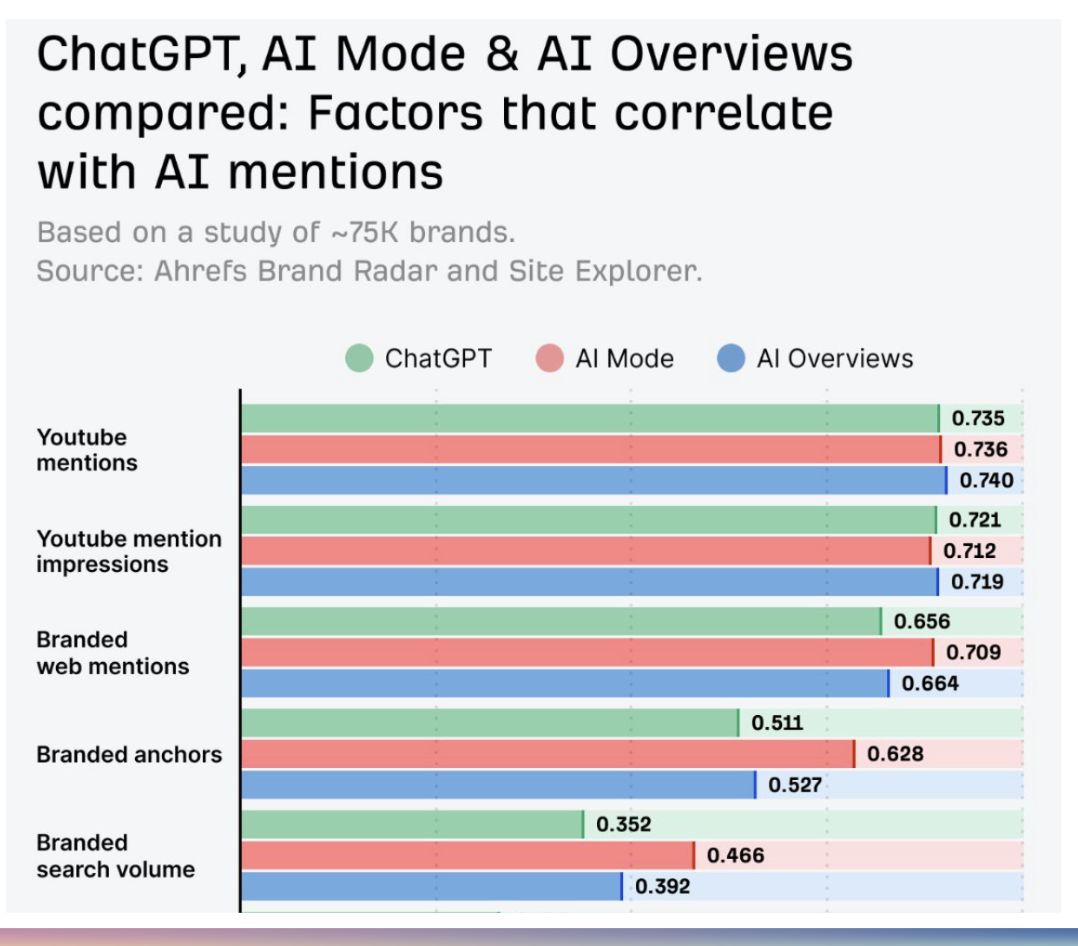
If nobody’s saying your brand out loud on YouTube, you’re leaving the strongest signal on the table. One good walkthrough video, or a mention in someone else’s, can do more for AI visibility than most of the technical checklist.
3. Diversify your traffic on purpose
Google still sends the most traffic, so this isn’t about abandoning it. It’s about not betting the business on it.
As organic clicks get squeezed, every advertiser chasing the same demand crowds into paid, which means the auction you were comfortably winning last year now costs more for the same volume. OpenAI is building its own ad surface too, and I broke down what ChatGPT ads mean for brands.
If you’re moving budget into paid, spend an hour with the ad fraud guide first. More than half of web traffic is automated now, and paying a higher price per click for bot impressions is a bad trade.
4. Monitor, then experiment
Search behavior is changing faster than any annual planning cycle can track. Two habits keep you grounded:
- Watch your AI referral traffic. It’s small today. The trend is what matters, so track it before it’s a line item your CFO asks about.
- Audit yourself monthly. Type your brand and your top category questions into ChatGPT, Gemini, and Perplexity, then write down where you show up.
That second habit works better when you ask properly. The T.A.L.K. method is the four-step version I use, and it takes about five minutes to learn.
The old game was ranking. The new game is being the answer.
Where this leaves you
Search isn’t dying. It’s splitting into pieces, and your buyers are already spread across them.
Here’s what I find encouraging: almost nobody is doing this work yet. Most teams are still staring at a Google dashboard, wondering why the line keeps sliding. You now know where the clicks went and what gets a brand picked.
So do the five-minute version today. Type your top three category questions into ChatGPT, Gemini, and Perplexity. Write down where you show up and where you don’t. That list is your next quarter of work.
If you want the wider map of how these tools fit together, start with the AI marketing hub.
I send a free read twice a week on what’s changing in how people find things, and the moves I’m making in my own stack because of it. Subscribe free.