
Your customer is using a chatbot right now. They also think it’s spying on them. Both things are true at once, and most brands are only marketing to the first one.
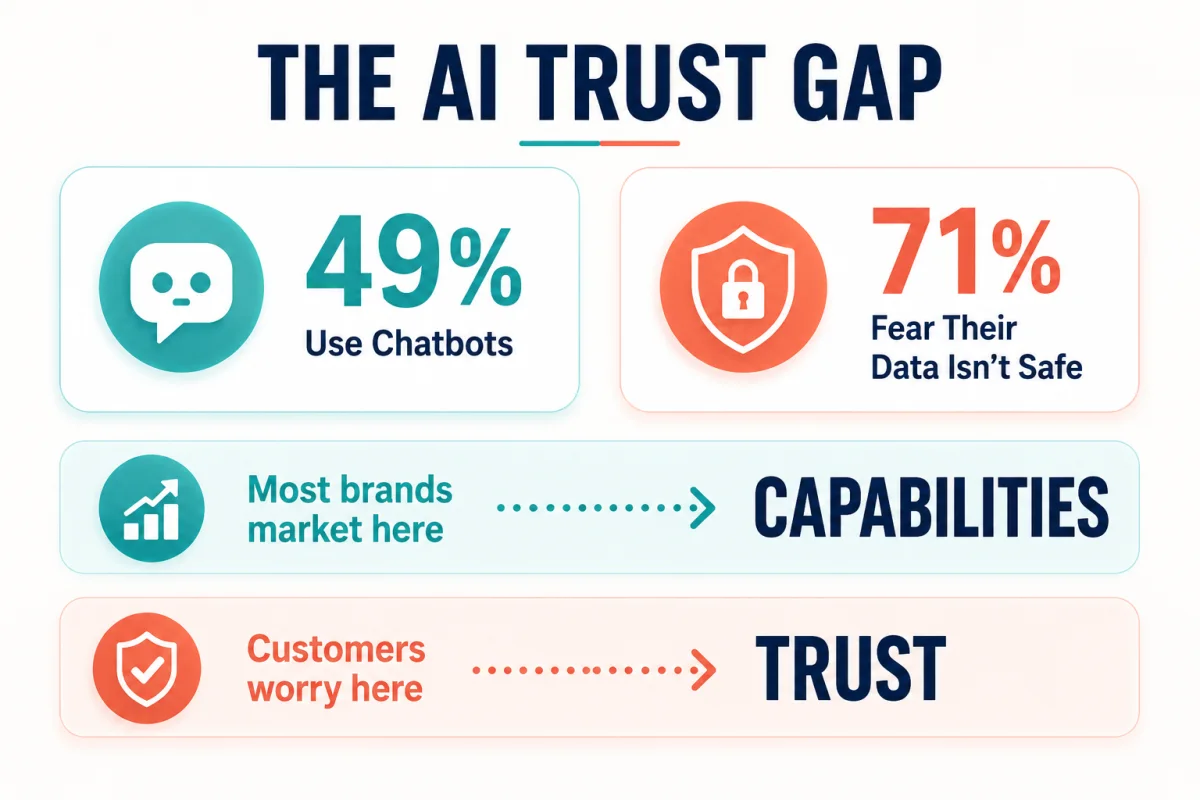
New data from Pew Research Center’s “Americans and AI 2026” survey (5,119 U.S. adults) puts that tension in sharp relief. Chatbot adoption hit 49%, up from 33% just 18 months ago. ChatGPT alone is now used by 44% of American adults, more than double its 2023 reach. AI is mainstream.
But pull back and look at what those same users believe.
- 71% predict AI will make their personal information less secure.
- 67% have little or no confidence in the government’s ability to regulate AI effectively.
- 60% don’t trust that U.S. companies are developing AI responsibly.
- 63% say AI is advancing too quickly.
They use it anyway. That’s the paradox. And it’s the most important thing you can understand about AI marketing right now.
Your customer is using a tool they don’t trust
This isn’t cognitive dissonance. It’s a rational trade. Your customer uses ChatGPT because the productivity gain is real enough to swallow the discomfort. But “useful enough to tolerate” and “trusted” are not the same thing.
Think about what that does to the relationship. They’re already skeptical. They’re watching. And the moment your brand confirms the suspicion, you’ve validated every fear they have. A vague privacy policy does it. So does a boastful claim about what your AI can “see.” I’ve made that error.
Marketing teams aren’t thinking about this. They’re marketing capability. Faster. Smarter. More efficient. It reads like a spec sheet. We need to meet our customers where they actually are, which is somewhere between AI curious and unnerved.
“The kids will get over it” is wrong
You’d assume younger adults are more comfortable with AI. Grew up online, early adopters, supposedly less precious about data privacy. You know the story. The Pew numbers kill it.
Among adults aged 18–29, 48% say AI’s impact on society will be negative. That’s higher than the 39% of 30-to-49-year-olds and the 37% of adults 50 and older. Younger adults are also the most likely to expect AI to hurt them personally (37% versus 28% for the 50-plus crowd).
So the “younger generation will come around” story is backwards. The backlash skews young. The skepticism skews young. If your strategy is quietly waiting for generational attitudes to drift your way, you’re betting on something the data says may not happen.
What we are missing
Don’t do the predictable thing with numbers like these. Ignore the trust findings. Double down on capability. Keep racing to announce what AI can do next. More features. More case studies about AI slop.
That leaves an entire lane wide open: trust, transparency, plain-English about what your AI actually does. Almost nobody’s running in it. That’s where I’m going.
You can’t out-feature the concern. You can out-trust it.
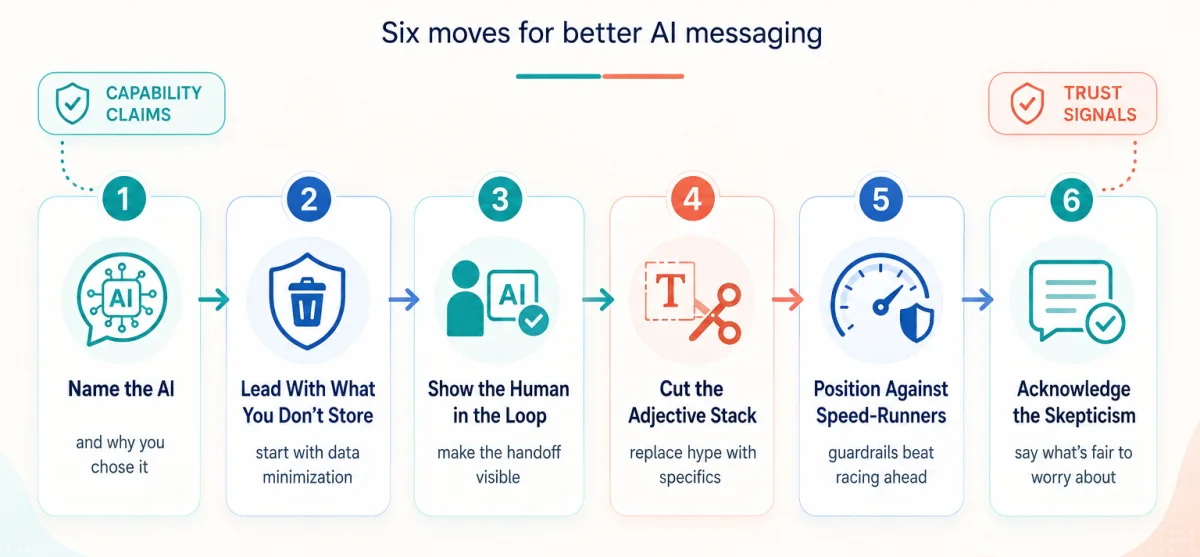
This isn’t positioning or spin. It’s what you actually say and do. Six moves:
1. Name the AI you use, and say why you chose it.
“We use [X] because [reason]” beats “powered by AI” every time. It tells customers you know the models have tradeoffs and you made a deliberate call. “Powered by AI” tells them nothing, except maybe that you didn’t think too hard about it.
2. Lead with what you don’t store.
Most brands lead with what their AI can do. Flip it. Start with your data-minimization posture. “We don’t retain your conversation history after the session ends” is a more powerful trust signal than any capability claim. 71% of your customers are worried about their data. Answer the question before they have to ask it.
3. Show the human in the loop, and where the AI stops.
Where does your AI decide on its own, and where does a person step in? Customers want to know. Remember, 63% think AI is moving too fast. The antidote isn’t to actually slow down. It’s to be explicit about where human judgment still sits. “Our AI drafts the recommendation; a strategist signs off before it reaches you.” That’s a concrete trust anchor.
4. Cut the adjective stack.
Intelligent. Powerful. Advanced. Revolutionary. Those are the exact words customers now associate with companies sprinting ahead without thinking about the consequences. They’ve heard the pitch. They’re tired of it. Replace the adjectives with specifics. What does it actually do? How am I protected?
5. Position against the speed-runners.
You don’t have to name OpenAI or Google. Just position against the “race ahead” instinct. “We ship slower than some. On purpose.” Or: “Plenty of tools will hand you an AI that does everything. We’d rather give you one that does the right things, with guardrails.”
6. Acknowledge the skepticism, in writing.
Write about AI trust. Write about what’s fair to worry about. Write the piece your customer has been waiting for someone credible to publish. Not a hot take about how AI is dangerous. Not a puff piece about how AI saves everything. Trust will be the separator, and it’s earned.
The numbers
What is the 49%/71% split telling us?
Not that customers are confused or irrational. They’ve made a calculated trade: use the useful thing, keep a wary eye on it. That’s me.
My question is whether your brand meets them there or keeps blasting AI capability into the void?
Trust is the scarce asset right now. Not intelligence. Trust. Distribution is going to win again in this AI battle and the rails run on brand trust.
AI adoption is already high. Don’t be the brand that never addressed the thing they were worried about.
What to do this week
Easiest starting point: open your current AI copy and count the adjectives. “Intelligent.” “Powerful.” “Advanced.” “Seamless.” Cut half of them and replace with your unique specifics.
Higher-leverage move: write the trust piece your customer hasn’t seen from anyone yet. Not defensive. Not a legal disclaimer in disguise. A real, first-person take on how you think about AI, data, and limits.
Your customer is already using AI. They just don’t trust the brands behind it. Decide which side of that gap you want to be on.