
AI Search & GEO · Updated October 2026
GEO: What Works and What Does Not in 2026
What is earning AI citations in October 2026, what Google says to ignore, and how to measure it without a fake AI rank. A sourced guide from Alec Newcomb.
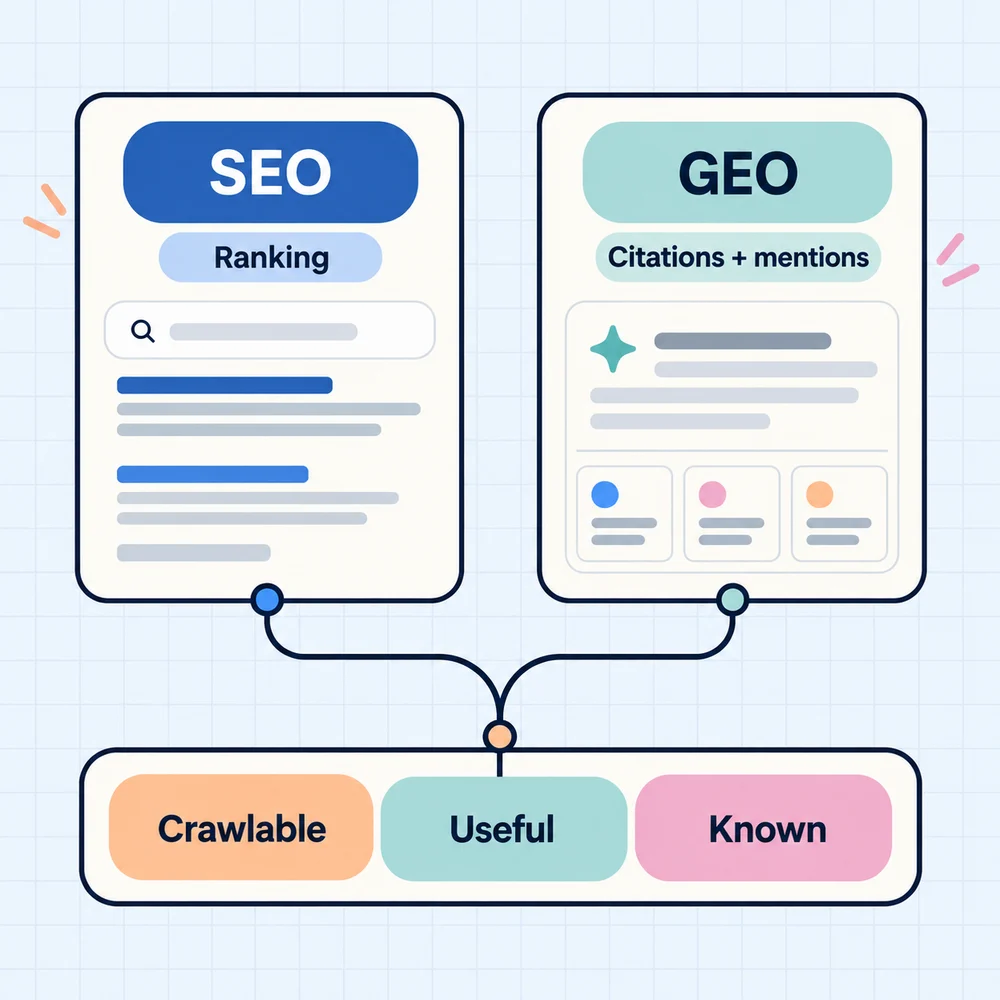
Generative engine optimization (GEO) is the work to get your brand mentioned and cited in AI answers. These answers include Google’s AI Overviews and AI Mode, ChatGPT, Gemini, Claude, Perplexity and Copilot. Google’s May 2026 guide calls GEO “still SEO,” because AI answers come from the same index. That is mostly correct. The foundation is the same. The scoreboard is different.
I ran a search engine in 1999. People sold shortcuts then, and they sell them now. For this October 2026 update, I examined Google’s documentation, its patents, the 2026 court decisions, the trade press and the data studies. I had two questions:
- What increases AI visibility?
- What can you stop paying for?
Each number on this guide has a source and a date. The full resource library is at the bottom.
5 GEO Myths to STOP Buying
SEO isn’t dead, llms.txt isn’t a shortcut, and a “#1 AI ranking” may be gone tomorrow. The five myths in 30 seconds. The full breakdown, with 2026 data, is in the myths post further down.
AI search in Q4 2026: the numbers
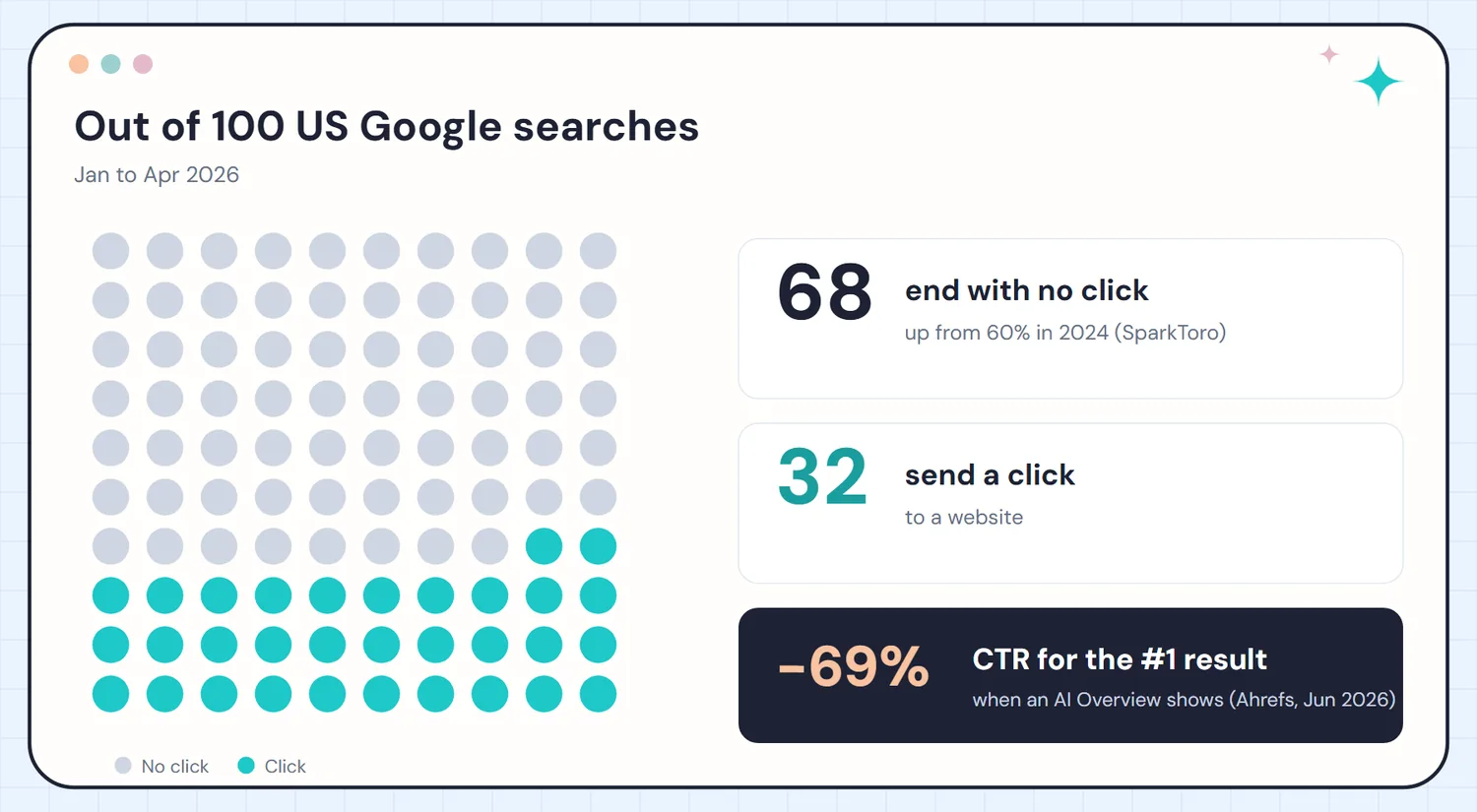
Six numbers that explain the shift, each with a dated source
| Number | What it measures | Source |
|---|---|---|
| 68% | of US Google searches ended without a click (Jan to Apr 2026), up from 60% in 2024. | SparkToro |
| -69% | click-through rate for the #1 US result when an AI Overview shows (Jun 2026), worse than -58% six months earlier. | Ahrefs |
| 83% | of US branded searches now show an AI Overview (Sep 29, 2026), up from a 61% average in July. | Ahrefs |
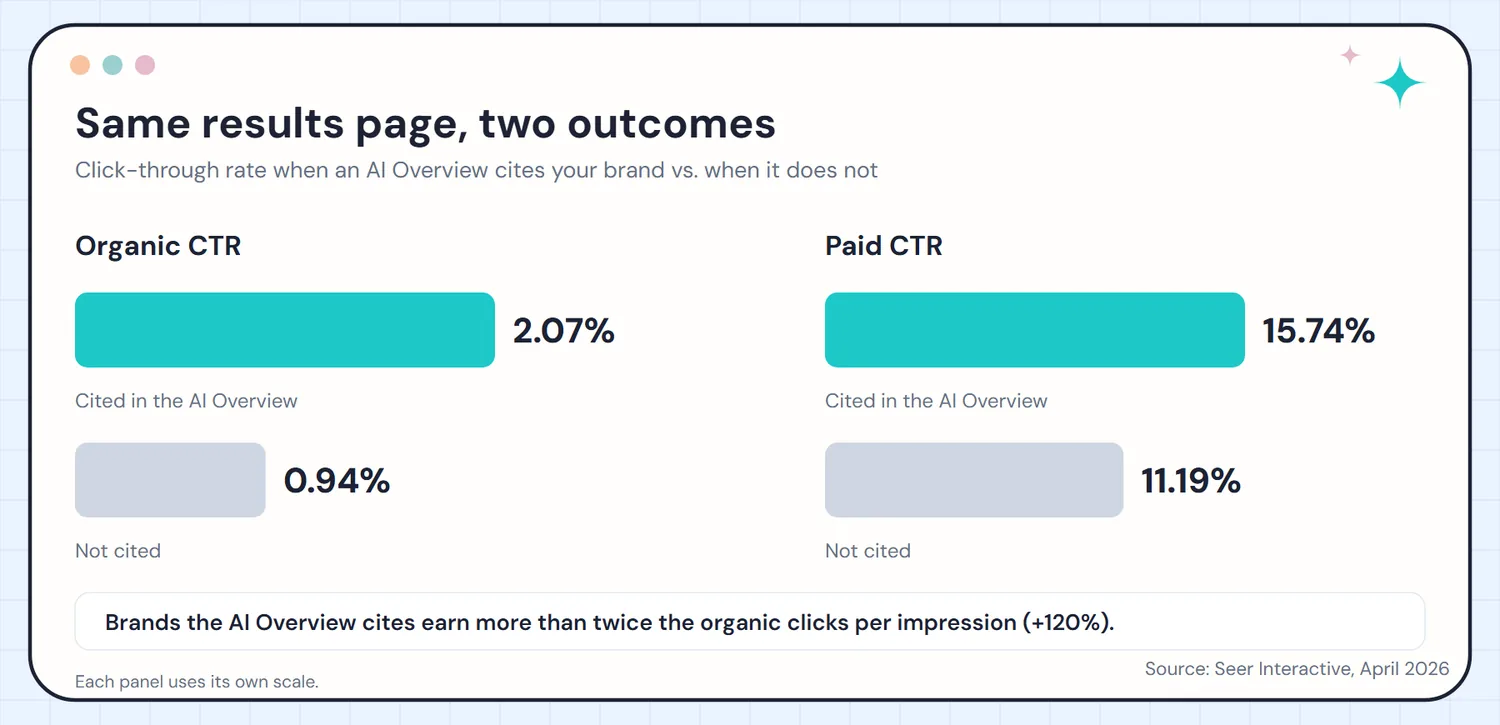
| +120% | more organic clicks per impression for brands cited in the AI Overview vs not cited on the same results page (Apr 2026). | Seer Interactive |
| 38% | of AI Overview citations ranked in Google’s top 10 (Mar 2026), down from 76% in July 2025. | Ahrefs |
| ~1% | of site sessions came from AI tools across 13,770 domains (2026). Small, but it converts. | Conductor |
New this quarter: three changes to act on
AI Overviews moved onto brand searches
They showed on 83% of US branded searches by Sept 29, 2026. A search for your own name now shows an answer that you do not control. Ahrefs found that 72% of these answers cited Wikipedia. YouTube and LinkedIn were next. Search for your brand this week and correct what the answer says.
AI Overviews hand off to AI Mode
After Google I/O in May, a follow-up question from an Overview continues in AI Mode. Glenn Gabe found Overview links that open AI Mode, not a web page. Thus an “AIO click” is not a clean metric now.
The spam updates continued
Google released spam updates in March, June, August and September 2026. The September update started on Sept 24, and the rollout continued into October. Listicle farms and scaled pages usually lose the most.
Why zero-click is the CEO’s problem, not the SEO’s
In a zero-click search, the searcher gets the answer on the results page and does not visit a site. About two thirds of US Google searches are now zero-click. In Pew’s March 2025 data, people clicked a regular result on 8% of searches with an AI summary. They clicked on 15% of searches without one. They clicked a link in the summary only 1% of the time.
Publishers felt it first. Chartbeat found that in two years, small publishers lost 60% of their search referrals. Mid-size publishers lost 47%, and large publishers lost 22%. Size helped, but it did not make a publisher safe.
Google’s line is that it still sends “billions of clicks to websites every week” through AI features. Google did not publish a click-through rate for that claim. Google also started to put ads inside AI Mode answers and inside the AI’s own recommendation lists. Thus each commercial answer has less unpaid space.
Send this to your CFO.
Seer Interactive’s April 2026 study compared brands on the same results page. When an AI Overview cited the brand, organic CTR was 2.07%. When it did not cite the brand, organic CTR was 0.94%. Paid CTR was 15.74% against 11.19%.
AI referrals are small, about 1% of sessions. But Adobe found that on US retail sites in July 2026, they converted 60% better than other traffic. If you are not in the answer, buyers do not see you.
What works in GEO now
Ten things earn citations in AI search, and the order matters: rank first, then earn the mentions. The full list is in a short PDF, with the evidence and the source behind every move.
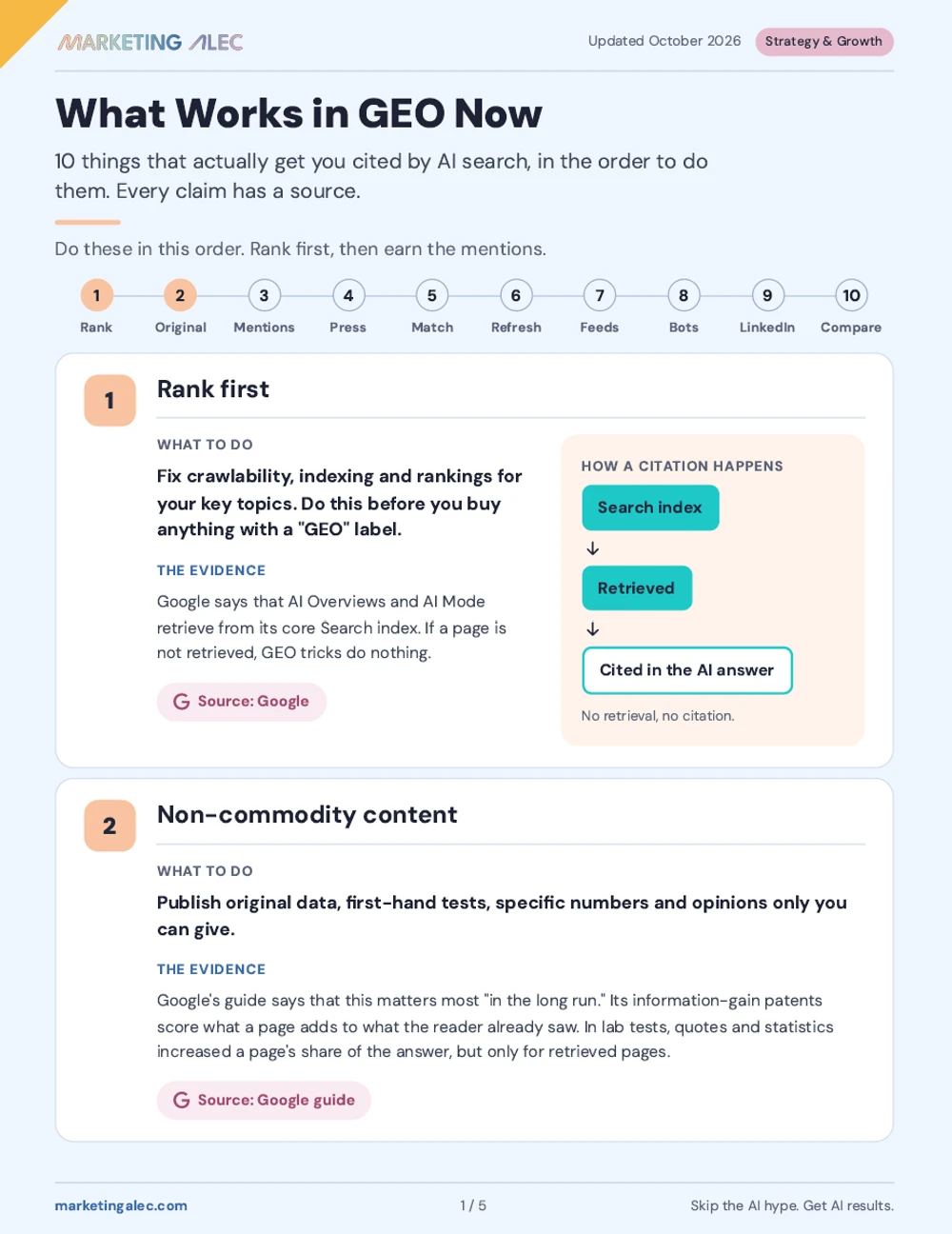
Get the What Works in GEO Now PDF
The ten things that actually get you cited by AI search, in the order to do them, with the evidence and source behind each one.
Data from the field: a case study
ScaledOn does SEO for the continuing education site of a leading university. We did the fundamentals. We fixed the technical base, made pages deeper, added internal links and earned better rankings. We did not use llms.txt or AI hacks.
These are the results of old-fashioned SEO on AI visibility:
Client results, 2024 vs 2025
| Metric | 2024 | 2025 |
|---|---|---|
| Average ranking position | 18.4 | 11.2 |
| Tracked keywords in the top 10 | 23% | 47% |
| Share of voice | 12% | 21% |
| Monthly organic conversions | 342 | 578 |
| Organic conversion rate | 2.1% | 3.4% |
| Featured snippets | 0 | 7 |
| People Also Ask appearances | 2 | 18 |
| Average words per page | 450 | 1,250 |
| Internal links | 1,250 | 3,420 |
| Crawl errors | 127 | 12 |
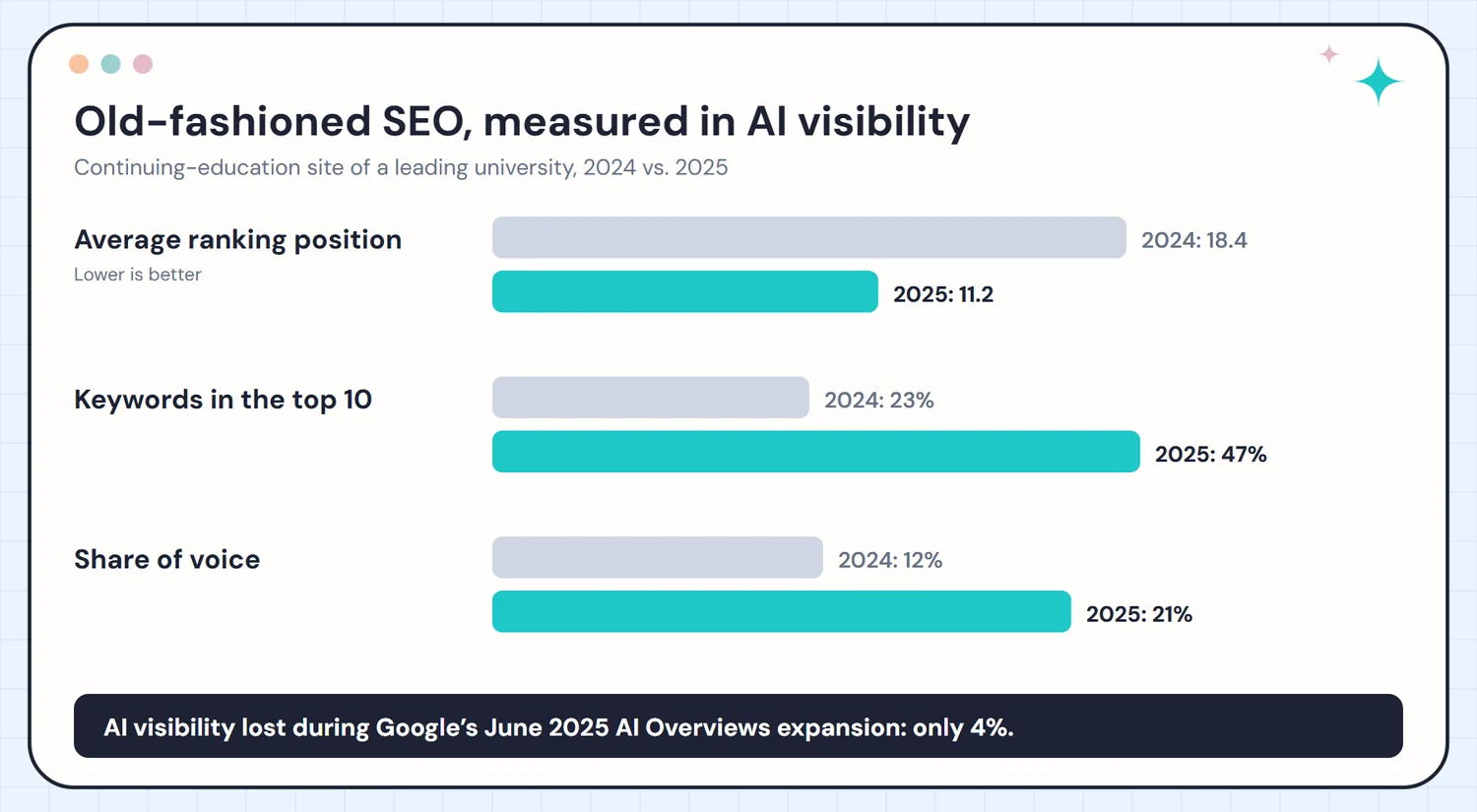
The AI result is the important one. During Google’s June 2025 expansion of AI Overviews, the site lost only 4% of its visibility. In the same period, monthly organic conversions continued to increase. Rankings, depth and a clean technical base protected the site. A special AI tactic did not.
What does not work (and what backfires)
Some of these only waste budget. Others now cause a penalty. Google added “manipulating generative AI responses” to its spam policies in May 2026.
llms.txt
In May 2026, 97% of llms.txt files got zero requests (137K domains). Google says that Search ignores them and that they “neither harm nor help.” Ahrefs
Schema as an AI hack
Ahrefs monitored 1,885 pages that added schema. There was no measurable lift in ChatGPT, AI Mode or AI Overviews. Google says that AI features need no special markup. Google retired the FAQ rich result on May 7, 2026. Keep schema for SEO. It is not a new AI lever. Ahrefs
Chunking pages for LLMs
Danny Sullivan of Google said: “we don’t want you to do that.” Google’s guide says that there is no ideal page length. You do not need to cut content into small pieces. Search Engine Roundtable
Self-promotional “best X” listicles
When an AI Overview cited a brand’s own “best” listicle, it did not recommend that brand 69% of the time. Early 2026 updates hit sites with 100+ of these pages. Lily Ray
Scaled AI pages and one page for each prompt
Google’s spam policies now include “manipulating generative AI responses.” The number of pages on a site has only a ~0.19 correlation with AI visibility. Google released four spam updates in 2026. Google spam policies
Hidden prompts (“Summarize with AI” injection)
Microsoft found 31 companies that put hidden “recommend us” instructions in AI summary buttons. Microsoft now filters these instructions as a security threat. Microsoft
Betting on one channel
In one week of August 2026, Reddit’s share of ChatGPT citations fell 86% (3.8% to 0.5%). Reddit stayed near the top in AI Overviews and AI Mode. Each engine changes on its own. A plan for one platform can fail in one day. Promptwatch
Tracking an AI “rank”
If you send the same prompt twice, you get the same brand list less than 1 time in 100. Google says that no third-party tool can see its AI systems. SparkToro
“Rank in Bing, get cited by ChatGPT”
A 400-query study found that only 27% of ChatGPT citations matched Bing’s top 20, with fan-out included. Bing indexing helps, but it is not sufficient. AI+Automation
Buying fake mentions
Google says: “seeking inauthentic ‘mentions’ across the web isn’t as helpful as it might seem.” Paid listicle placements can also break FTC rules on fake reviews. Google guide
I Ran a Search Engine in 1999. 5 GEO Myths to Stop Buying.
“SEO is dead.” “AEO, GEO and SEO are separate jobs.” “You need llms.txt and schema.” “AI tools show your rank.” “Rank #1 in ChatGPT in 24 hours.” I took each one apart with 2026 data. Read it before you sign the next GEO retainer.
How AI search picks its sources: what Google’s patents say
Google confirmed the broad shape in its 2026 guide. Its patents fill in the likely mechanics. One caveat up front: a patent shows what Google invented, not what it ships. Treat these as a map, not a manual.
Fan-out
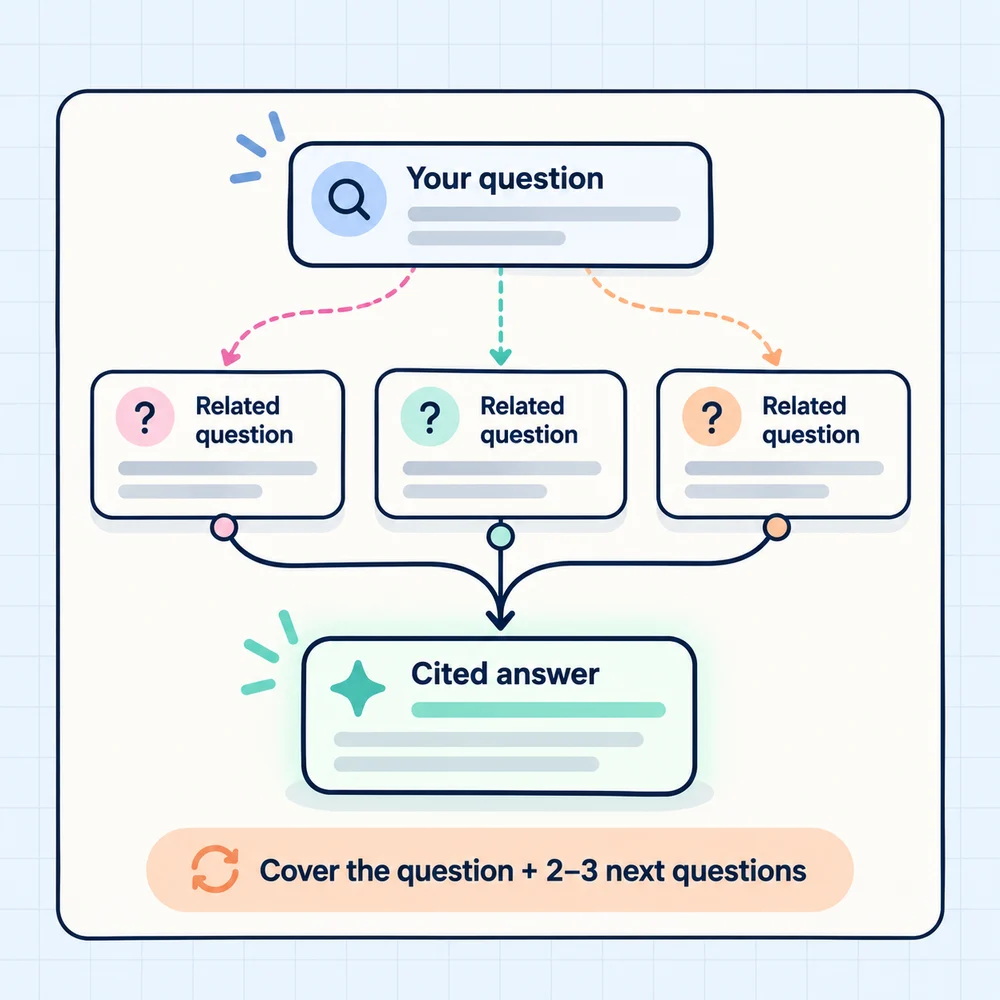
The model changes your question into many related sub-queries and searches them for the user. Google confirmed this for AI Mode. Its “Search with stateful chat” and “multifaceted queries” patents describe the same idea. They also select sub-queries for diversity. US20240289407A1
Retrieval
Results come from the regular Search index, “relying on our core Search ranking systems.” Sub-queries make the net wider. An IMC 2026 study found that about 30% of cited domains were not on the first results page for the original query. The same study found that the cited page did not support 11% of AI Overview claims. arXiv 2605.14021
Passage selection
The system selects the passage that answers each sub-question. Google’s older answer-passage patents give weight to heading structure, complete sentences, and real tables and lists. US9940367B1
Synthesis and links
An LLM writes the answer. Then it links each claim to the passage that supports it best (the generative summaries patent, US11769017B1). A page that only repeats other sources adds nothing. Google’s information-gain patents describe a score for this. US12013887B2 (information gain)
Ranking gets you retrieved, because retrieval starts from the index. Fan-out makes the field wider. Thus an AI answer can cite you for a query that you did not target, if you cover the sub-questions. Each passage must also be complete. Give it a clear heading, then the full answer with the specific facts in one place.
Some SEOs tell you to “chunk” content. Google says not to. Write a heading that a new reader can understand. Then answer it in the next few sentences, on the same page. Do not break pages into fragments. Do not make a thin URL for each sub-question.
The honest academic view comes from a July 2026 survey of 45 GEO studies: no technique showed a stable effect across platforms over time. Only relevance and retrieval into the context window gave consistent results. All other tactics are fragile.
Beyond Google: ChatGPT, Gemini, Claude, Perplexity and Copilot
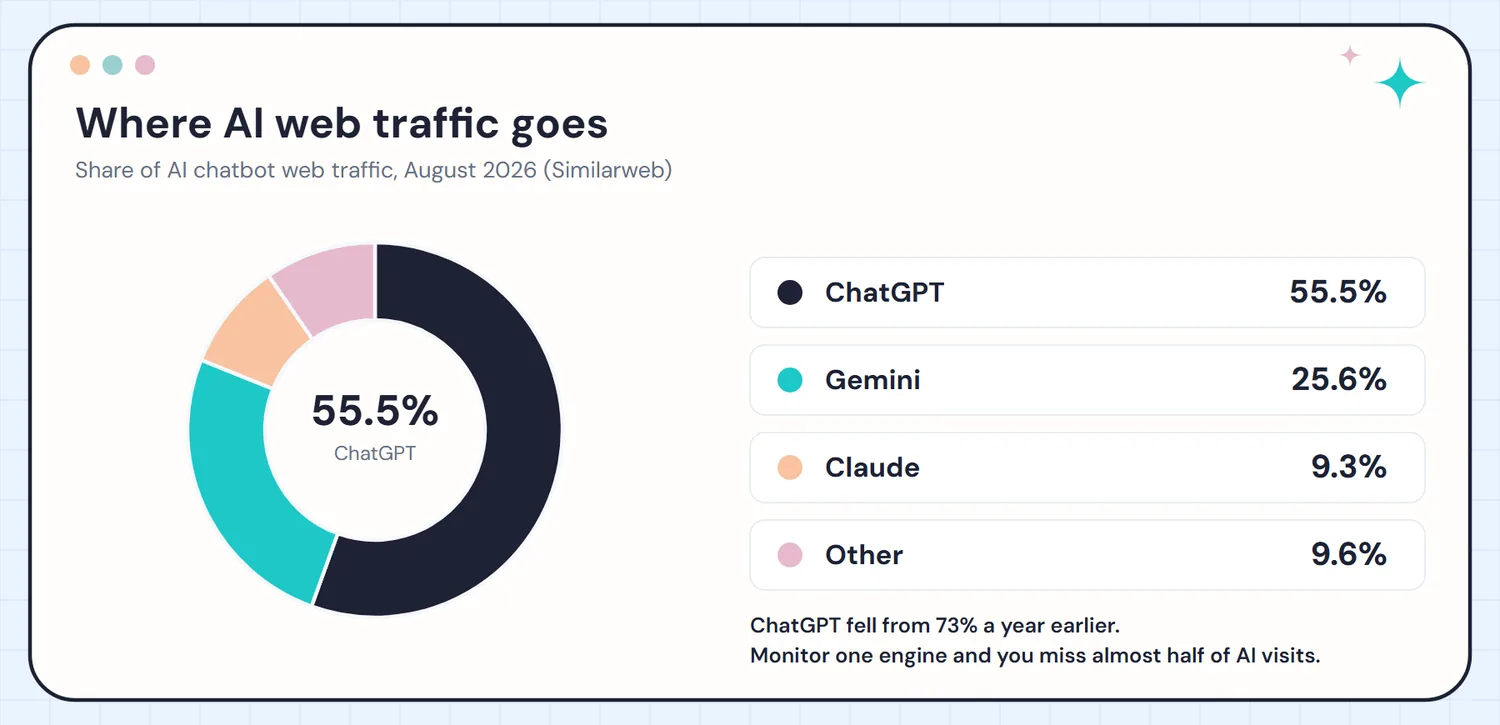
Google still sends about 88% of search referrals (Cloudflare, July 2026), AI chatbots send about 0.4% of all referral traffic (Statcounter, Sept 2026). But the AI market itself is divided now. ChatGPT’s share of AI web traffic fell from 73% to 55.5% in a year, while Gemini reached 25.6% and Claude 9.3% (Similarweb, August 2026). If you monitor only ChatGPT, you do not see almost half of AI site visits.
Google AI Overviews and AI Mode
Where answers come from: Google’s Search index plus fan-out. AIO has 2.5B monthly users and AI Mode has more than 1B (May 2026). AIO follow-up questions go to AI Mode. Ads now show inside AI Mode answers.Your move: Classic SEO, Merchant Center and Business Profile. Keep the Search Console generative AI control set to include.
ChatGPT
Where answers come from: Its own search index (OAI-SearchBot) plus training data. About 1.2B weekly users (OpenAI DevDay, Sept 2026). Similarweb found it cited a source in 6.8% of answers (May 2026, up from 1.6% a year earlier) and showed ads in about 26% of Free and Go responses.Your move: Allow OAI-SearchBot. Submit a product feed. Build brand mentions. Expect clicks to your homepage, not to other pages.
Gemini app
Where answers come from: Google’s stack. 1B+ monthly users (Aug 2026), and 63% talk to it by voice. Apple’s next Siri models are built on Gemini.Your move: Same as Google. Build strong entity and brand signals, because voice answers almost never send a click.
Claude
Where answers come from: Most answers come from training data. Live web results align closely with Brave Search (third-party testing).Your move: Allow Claude-SearchBot and Claude-User (both obey robots.txt). Make sure that Brave indexes your site.
Perplexity
Where answers come from: PerplexityBot index. Under 1% of AI site visits but 7.7% of AI chatbot referrals (Statcounter, Apr 2026). It dropped ads in 2026.Your move: Allow PerplexityBot. Visibility here is organic only.
Copilot and Bing
Where answers come from: Bing’s index. Microsoft is more pro-structure and pro-schema than Google.Your move: Connect Bing Webmaster Tools, use IndexNow, read the AI Performance report.
Grok and DeepSeek
Where answers come from: Grok had 2.4% and DeepSeek 3.4% of AI web visits (Aug 2026). Both had more visits than Perplexity and Copilot.Your move: Examine your referral logs before you invest. Visits are not referrals.
Which bots to let in
Every major AI company now runs separate bots for training, search and user-triggered fetches. If you block a search bot, that engine’s answers do not include you. If you block a training bot, you make a bet about what future models will know about you. This is most important for Claude, because its answers come mostly from training data.
AI crawlers by purpose
| Company | Training (your call) | Search (allow) | User-triggered (allow) |
|---|---|---|---|
| OpenAI | GPTBot | OAI-SearchBot | ChatGPT-User (“may not” follow robots.txt) |
| Anthropic | ClaudeBot | Claude-SearchBot | Claude-User (follows robots.txt) |
| Perplexity | None declared | PerplexityBot | Perplexity-User (generally does not) |
| Google-Extended (Gemini only) | Googlebot | Search Console AI control decides AIO and AI Mode |
For agentic commerce, OpenAI and Google went in different directions in 2026. OpenAI stopped in-chat Instant Checkout. It changed ChatGPT shopping to discovery from merchant feeds. Google released its Universal Commerce Protocol. It puts a checkout button in AI Mode and Gemini, and the retailer stays the seller of record. For most brands in Q4, the work is the same: clean product feeds and complete Merchant Center attributes.
What the courts and regulators changed in 2026
In 2026, AI search got rules. These five changes affect your plans:
You can now opt out of AI Overviews and AI Mode.
The “Search generative AI control” in Search Console became available worldwide on Aug 31, 2026. It removes a site from AI Overviews, AI Mode and Discover AI features. It does not change classic rankings. It does not apply to the Gemini app. For almost all brands, stay in, because those citations are your visibility. If your business depends on the click, do a careful test first. Source
US courts will not stop AI Overviews.
On Sept 30, 2026, Judge Mehta dismissed the Penske Media and Chegg antitrust suits about AI Overviews: “an expectation is not an agreement.” This decision does not settle copyright, and an appeal is possible. For your plans, assume that AI answers will stay in the US. Source
Regulators are the lever that works.
On June 3, 2026, the UK CMA required a publisher opt-out and clear attribution. On June 17, it required fair ranking, which includes AI Overviews. The EU antitrust probe of Google’s use of publisher content for AI started in December 2025 and is still open. Separately, the EU fined Google €890M under the DMA in July 2026. The fine was for self-preferencing in Search and for Play Store steering. The EU says that talks continue about how these rules apply to AI Overviews and AI Mode. Source
Google started to pay for contributions.
An invite-only “AI contribution pilot” pays about 100 publishers. Google pays when their content has a large effect on answers in Gemini, AI Overviews and AI Mode. The payments are very different. One early publisher will probably get more than $1M each year. Smaller sites got less than $1,000 in several months. It is a signal, not a revenue line. Source
Your CDN can block AI crawlers without your knowledge.
After Sept 15, 2026, the Cloudflare settings “Block” and “Block on pages with ads” also stop Googlebot, Bingbot and Applebot. Thus they also remove you from classic search. For new ad-supported domains, the recommended presets block agent crawlers on ad pages. To refuse only training, use “Disallow AI Training.” Do an audit of these settings. Source
How to measure GEO without fooling yourself
There is no rank to report. The same prompt gives the same brand list less than 1 time in 100. From one day to the next, 69% of the sources behind an answer change. Profound found that the median cited page loses half of its citation share in 11 days after its peak. Personalization adds more noise. You can measure these items:
Google impressions
Search Console’s Generative AI performance report shows when your links appeared in AI Overviews, AI Mode and Discover. It shows impressions only, with no clicks or queries, and data starts May 18, 2026. Since Sept 24 it also covers Lens and Circle to Search.
Copilot citations
Bing Webmaster Tools’ AI Performance report is the only first-party report that counts actual citations, plus the grounding queries behind them.
Appearance rate everywhere else
Run the same prompt set across four or more engines, several times, every month. Track how often you are mentioned and how often you are cited, as two numbers. Semrush found 62% of AI citations link a page without naming the brand.
Business outcomes
Report AI referrals as their own channel, and watch branded search and direct traffic. Microsoft recommends those as proxies because, in its words, “measurement is a bit broken right now.”
Your Q4 2026 GEO checklist
- Open Search Console. Make sure that the generative AI control is set to include.
- Read the Generative AI performance report in Search Console each month.
- Search for your brand name. If an AI Overview shows, examine what it says and which sources it cites.
- Correct your Wikipedia, YouTube and LinkedIn pages first. AI Overviews cite them most for brand searches.
- Do an audit of robots.txt and your CDN settings together. Allow search bots and agent bots.
- Make a decision about training bots. This decision controls what future models know about you.
- Connect Bing Webmaster Tools. Use its grounding queries as free prompt research.
- Turn on IndexNow.
- Select your ten money topics. Fix their rankings and use each query in your headings.
- Cover the two or three sub-questions that buyers ask next for each topic.
- Publish one piece of non-commodity content each month: original data, a real test, or a number that nobody else has.
- Update your top 20 pages each quarter with new facts. Do not change only the date.
- Get authentic mentions where AI looks: press, YouTube, LinkedIn, reviews and forums.
- Remove or rewrite self-promotional “best X” listicles. Replace them with fair comparisons.
- Clean your feeds: Merchant Center conversational attributes, Business Profile and the ChatGPT product feed.
- Measure appearance rate, not rank. Send the same prompts to four or more engines each month.
- Stop payments for llms.txt, “AI schema” packages and AI rank positions.
Is SEO dead?
No. Rankings still get you retrieved. They do not guarantee the click now.
Frequently asked questions
What is generative engine optimization (GEO)?
How is GEO different from SEO?
Is organic search traffic declining because of AI?
Does llms.txt or schema help you get cited by AI?
Is it a good idea to opt out of AI Overviews and AI Mode?
How do you measure GEO?
What content works best for GEO?
Go deeper: from the newsletter
The data, the threat, and the tactics, in full:
I Was Wrong: You’re Going to Lose MORE Traffic
Why AI answers take more clicks than most teams planned for.
Zero-Click Search Hits 60%
The numbers behind the zero-click shift, and a survival plan.
Google’s AI Problem: How Chatbots Are Eating Search Alive
What the chatbot share of search means for your brand.
AI Myth Busting: llms.txt
Why the file half the internet added did nothing measurable.
Resources and sources
209 sources behind this guide: Google’s own documentation, its patents, academic research, 2026 data studies, court filings and regulators, posts from X, and the YouTube talks worth your time. Links were checked on October 6, 2026. Data and dates are as published by each source.
Start here
The twelve primary sources that carry most of this guide.
- Optimizing your website for generative AI features on Google Search
Google Search Central · May 2026 - Spam policies for Google web search
Google Search Central · Aug 2026 - Search generative AI performance reports
Google Search Central Blog · Jun 2026 - New controls for website owners (AI opt-out)
Google · Aug 2026 - AI Performance in Bing Webmaster Tools
Bing · Feb 2026 - AIO impact on Google CTR: 2026 update
Seer Interactive · Apr 2026 - Only 38% of AI Overview citations rank in the top 10
Ahrefs · Mar 2026 - AI brand visibility correlations (75K brands)
Ahrefs · Dec 2025 - In 2026, less than one third of Google searches still send a click
SparkToro · Jun 2026 - The fan-out effect: what happens between a query and a citation
AirOps · Apr 2026 - A critical survey of GEO (2023 to 2026)
arXiv · Jul 2026 - CMA secures fairer deal for publishers in Google Search
UK CMA · Jun 2026
The full library
Tap a category to open it.
Google and Bing: official guidance (24)
The primary sources. Start with Google’s AI optimization guide.
- Optimizing your website for generative AI features on Google Search
Google Search Central · May 15, 2026, updated Jul 10, 2026 - A new resource for optimizing for generative AI in Google Search
Google Search Central Blog · May 15, 2026 - Introducing Search generative AI performance reports in Search Console
Google Search Central Blog · Jun 3, 2026 - New opportunities, control and insights for website owners (AI opt-out)
Google · Jun 3, 2026, updated Aug 31, 2026 - Search generative AI control (help doc)
Search Console Help - Spam policies for Google web search (now covers AI responses)
Google Search Central · updated Aug 28, 2026 - Guidance on using generative AI content on your website
Google Search Central · updated Oct 1, 2026 - Guidance on third-party SEO tools, including “AEO” and “GEO” tools
Google Search Central · Jun 5, 2026 - Preferred sources (now in AI Mode and AI Overviews)
Google Search Central - Web multimodal Search performance reporting
Google Search Central Blog · Sep 24, 2026 - Update to the site reputation policy
Google Search Central Blog · Aug 28, 2026 - Search Central documentation changelog
Google Search Central · rolling - Google Search Status Dashboard (core and spam updates)
Google · rolling - Search Quality Rater Guidelines (current edition, PDF)
Google · Sep 11, 2025 - Google Search’s I/O 2026 updates
Liz Reid, Google · May 19, 2026 - Sundar Pichai’s I/O 2026 keynote
Google · May 19, 2026 - Alphabet Q2 2026 earnings remarks
Google · Jul 22, 2026 - A new generation of ads for the AI era of Search
Google Marketing Live · May 20, 2026 - AI in Search is driving more queries and higher quality clicks
Liz Reid, Google · Aug 6, 2025 - Introducing AI Performance in Bing Webmaster Tools
Bing Webmaster Blog · Feb 10, 2026 - Evolving role of the index: from ranking pages to supporting answers
Bing Search Blog · May 6, 2026 - Optimizing your content for inclusion in AI search answers
Microsoft Advertising · Oct 8, 2025 - GEO and AI search: from discovery to influence (part 2)
Microsoft Advertising · Apr 7, 2026 - AI Recommendation Poisoning
Microsoft Security · Feb 10, 2026
Google patents (17)
A patent shows what Google invented, not what it ships. Read these as hypotheses about the architecture.
- Generative summaries for search results (US11769017B1)
Google · granted Sep 26, 2023 · the AI Overviews blueprint - Generative summaries for search results (US11886828B1)
Google · granted Jan 30, 2024 · same family - Generative summaries for search results (US12118325B2)
Google · granted Oct 15, 2024 · same family - Search with stateful chat (US20240289407A1)
Google · published Aug 29, 2024 · AI Mode and query fan-out - Thematic search (US12158907B1)
Google · granted Dec 3, 2024 · themes and drill-downs - Utilizing LLMs in responding to multifaceted queries (US20250117381A1)
Google · published Apr 10, 2025 · sub-query selection for diversity - Generating query variants using a trained generative model (US11663201B2)
Google · granted May 30, 2023 · the ancestor of fan-out - Prompt-based query generation for diverse retrieval (WO2024064249A1)
Google · published Mar 28, 2024 · Promptagator: trains retrievers, often mislabeled “the fan-out patent” - Text ranking with pairwise ranking prompting (US20250124067A1)
Google · published Apr 17, 2025 - Query response using a custom corpus (US20240362093A1)
Google · published Oct 31, 2024 - User embedding models for personalization (WO2025102041A1)
Google · published May 15, 2025 - Contextual estimation of link information gain (US11354342B2)
Google · granted Jun 7, 2022 - Contextual estimation of link information gain (US12013887B2)
Google · granted Jun 18, 2024 - Scoring candidate answer passages (US9940367B1)
Google · granted Apr 10, 2018 - Context scoring adjustments for answer passages (US9959315B1)
Google · granted May 1, 2018 · heading hierarchy - AI-generated content page tailored to a user (US12536233B1)
Google · granted Jan 27, 2026 · shopping and ads landing pages - Informational grounding with respect to a generative model (US12189697B2)
Microsoft, not Google · granted Jan 7, 2025 · Bing and Copilot grounding
Patent analysis (9)
The SEOs who read these patents so you don’t have to.
- How AI Mode works
Mike King, iPullRank · May 27, 2025 - Query fan-out personalization
Lazarina Stoy, iPullRank · Mar 20, 2026 - Google’s thematic search patent
Roger Montti, Search Engine Journal · May 29, 2025 - Google’s information gain patent
Roger Montti, Search Engine Journal · Aug 15, 2024 - Google’s AI-generated landing page patent is limited to shopping ads
Roger Montti, Search Engine Journal · Mar 2, 2026 - Selecting candidate answer passages
Bill Slawski, Go Fish Digital · Oct 23, 2020 - Generating query answers
Bill Slawski, SEO by the Sea · May 8, 2022 - Google’s query fan-out
Ethan Lazuk · Jul 14, 2025 - LLM readability and chunk relevance
Olaf Kopp
Research papers (7)
The academic record on whether GEO tactics work.
- GEO: Generative Engine Optimization (the original paper)
Aggarwal et al. · KDD 2024 - C-SEO Bench: Does conversational SEO work?
Puerto et al. · NeurIPS 2025 · most methods ineffective or harmful - Generative engine optimization: how to dominate AI search
Chen et al., University of Toronto · Sep 2025 · earned-media bias - What generative search engines like (AutoGEO)
Wu et al., CMU · Oct 2025 - Optimizing visibility in generative engines: a critical survey of GEO (2023 to 2026)
Martinez · Jul 2026 · 45 studies reviewed - Measuring Google AI Overviews: activation, source quality, claim fidelity and publisher impact
Xu, Iqbal, Montgomery · IMC 2026 - Sufficient context: a new lens on RAG systems
Joren et al., Google · 2025
Data studies and trade press (51)
The 2026 numbers on clicks, citations and what moves them.
- In 2026, less than one third of Google searches still send a click
SparkToro · Jun 9, 2026 - AI Overviews reduce clicks: June 2026 update (Japanese edition, US and Japan data)
Ahrefs · 2026 - AI Overviews reduce clicks (update)
Ahrefs · Feb 4, 2026 - AIO impact on Google CTR: 2026 update
Seer Interactive · Apr 24, 2026 - AI search study featured in Fast Company: organic and paid CTR
Seer Interactive · Feb 9, 2026 - Zero-click marketing: AI Mode referral rates
Similarweb · Jun 10, 2026 - How users behave differently in AI Overviews and AI Mode
Kevin Indig, Growth Memo · 2026 - Google users are less likely to click when an AI summary appears
Pew Research Center · Jul 22, 2025 - Only 38% of AI Overview citations rank in the top 10
Ahrefs · Mar 2, 2026 - Most-cited domains in AI Overviews
Ahrefs · Sep 2026 - Most-cited domains in AI Mode
Ahrefs · Sep 2026 - AI Overviews on branded searches
Ahrefs · Oct 2, 2026 - AI brand visibility correlations (75K brands)
Ahrefs · Dec 12, 2025 - AI Overview brand correlation study
Ahrefs · May 26, 2025 - llms.txt study (137K domains)
Ahrefs · Jun 15, 2026 - Does schema help AI citations?
Ahrefs · May 11, 2026 - AI search trends
Ahrefs · Jul 24, 2026 - Content recency’s impact on AI visibility in 2026
Seer Interactive · Jul 24, 2026 - The fan-out effect: what happens between a query and a citation
AirOps · Apr 13, 2026 - What is AI reading?
Muck Rack · Feb 16, 2026 - The ghost citations study
Semrush and Growth Memo · Jun 9, 2026 - How ChatGPT reasoning modes change AI visibility
Semrush · Jun 30, 2026 - 2026 AI Visibility Index (126M prompts)
Semrush · Jun 26, 2026 - LinkedIn is the most-cited domain for professional queries
Profound · Mar 9, 2026 - Rank overlap after 16 months of AI Overviews
BrightEdge · Sep 18, 2025 - Why calling yourself “the best” could backfire
Lily Ray · Jun 17, 2026 - Reddit citations are dropping in ChatGPT
Promptwatch · Aug 2026 - AI citation volatility study (530K citations)
GetMentions · Jul 9, 2026 - The half-life of an AI citation is 11 days
Profound · Sep 30, 2026 - AIs are highly inconsistent when recommending brands
SparkToro · Jan 28, 2026 - Search happens everywhere: 41 websites with search activity
SparkToro · Mar 3, 2026 - AEO and GEO benchmarks report (13,770 domains)
Conductor · Jul 2026 - AI referral traffic by industry
Similarweb · Sep 3, 2026 - Gen AI stats: citation and ad rates inside ChatGPT
Similarweb · Jul 2026 - ChatGPT claws back web traffic share to 55.5%
The Decoder (Similarweb data) · Sep 7, 2026 - Search vs social vs AI chatbot referral share
Statcounter · live - ChatGPT referral traffic, May 2026
SE Ranking · Jul 9, 2026 - Adobe: AI referral traffic data, July 2026
Digital Commerce 360 · Aug 19, 2026 - Bing replication: where ChatGPT citations come from
AI+Automation · Apr 5, 2026 - Pageviews down: the AI impact on publishers
Chartbeat · 2026 - Google traffic down a third: 2026 trends report
Press Gazette · Jan 12, 2026 - Search isn’t dead, it’s fragmenting
Press Gazette · Jul 6, 2026 - The agentic internet bot report
Cloudflare · Jul 1, 2026 - Google’s new AI search guide calls AEO and GEO “still SEO”
Search Engine Journal · May 15, 2026 - Google: don’t turn content into bite-sized chunks
Search Engine Roundtable · Jan 2026 - 97% of llms.txt files got no requests
Search Engine Journal · Jun 16, 2026 - Google says llms.txt is comparable to the keywords meta tag
Search Engine Journal · Apr 17, 2025 - Mueller: acronym urgency means spam and scams
Search Engine Roundtable · Aug 15, 2025 - Illyes: normal SEO gets you into AI Overviews
Search Engine Roundtable · Jul 24, 2025 - Bing: optimize for AI search by following SEO guidelines
Search Engine Roundtable · Jul 31, 2025 - Search Console AI reporting changes (Mueller)
Search Engine Roundtable · Sep 16, 2026
AI engines, crawlers and agentic commerce (21)
Official bot docs and the commerce protocols that decide whether agents can buy from you.
- OpenAI crawlers (GPTBot, OAI-SearchBot, ChatGPT-User)
OpenAI docs - Does Anthropic crawl data from the web? (ClaudeBot, Claude-SearchBot, Claude-User)
Anthropic Help Center - Perplexity crawlers
Perplexity docs - Cloudflare: accountable mixed-use AI crawlers (Sept 15 defaults)
Cloudflare · Sep 15, 2026 - Cloudflare: new AI traffic options (search, agent, training)
Cloudflare changelog · Jul 1, 2026 - Cloudflare Content Signals Policy
Cloudflare · Sep 24, 2025 - Cloudflare: your content, your rules (Pay Per Use)
Cloudflare press release · Jul 1, 2026 - Agentic commerce tools and the Universal Commerce Protocol
Google · Jan 11, 2026 - Agentic checkout in Merchant Center
Google Merchant Center Help - Announcing the Agent Payments Protocol (AP2)
Google Cloud · Sep 16, 2025 - Agentic Commerce Protocol
OpenAI and Stripe - OpenAI refocuses ChatGPT shopping on discovery
TechInformed · Mar 30, 2026 - WebMCP early preview
Chrome for Developers · Feb 10, 2026 - OpenAI DevDay 2026: ChatGPT at 1.2 billion weekly users
Engadget · Sep 29, 2026 - ChatGPT reaches 900M weekly active users
TechCrunch · Feb 27, 2026 - Gemini app passes one billion monthly users
Google · Aug 11, 2026 - ChatGPT ads expand to Europe
Search Engine Roundtable · Aug 19, 2026 - Perplexity abandons AI advertising
MacRumors (via FT) · Feb 18, 2026 - Claude web search: Brave and TurboPuffer
Xponent21 · 2026 - Joint statement from Google and Apple (Siri on Gemini)
Google · Jan 12, 2026 - Siri AI is here
Apple Newsroom · Sep 14, 2026
Litigation and regulation (27)
Where the courts and regulators stand as of October 2026.
- Google wins dismissal of Chegg and Penske Media AI Overviews suits
The Globe and Mail (Reuters) · Oct 1, 2026 - Google’s AI Overviews publisher lawsuit win
Android Authority · Oct 2026 - Google files appeal challenging search remedies
PPC Land · Jan 2026 - Gemini’s rise proves search remedies must be strengthened (D.C. Circuit amicus)
American Economic Liberties Project · Aug 5, 2026 - Google won’t have to break up its ad tech business
AdExchanger · Sep 2026 - Ad tech case: proposed final judgments
AdExchanger · Oct 2026 - CMA secures fairer deal for publishers in Google Search
UK CMA · Jun 2026 - Google general search and search advertising case page
UK CMA - Publishers will be able to opt out of AI search thanks to new regulation
TechCrunch · Jun 3, 2026 - EU launches antitrust probe into Google’s AI search tools
TechCrunch · Dec 9, 2025 - European Commission opens Google AI investigation
Press Gazette · Dec 2025 - Commission fines Google €890M for DMA breaches (press release, PDF)
European Commission · Jul 23, 2026 - Brussels fines Google €890M under the DMA
Euronews · Jul 23, 2026 - The Munich ruling on Google AI Overviews
MediaLaws · 2026 - Google’s AI contribution pilot
Search Engine Roundtable · Sep 2026 - Google is paying 100 websites for AI contributions, but the amounts are tiny
Ars Technica · Sep 30, 2026 - Bartz v. Anthropic settlement receives final approval
Authors Alliance · Jul 21, 2026 - Third Circuit addresses fair use in AI training (Thomson Reuters v. Ross)
Ballard Spahr · Oct 2026 - Summary judgment briefing starts in the OpenAI copyright MDL
ChatGPT Is Eating the World · Sep 4, 2026 - Reddit can proceed with scraping claims against Perplexity
MediaPost · Aug 2026 - Reddit v. Anthropic remanded to state court
Crowell & Moring · 2026 - Google v. SerpApi: motion to dismiss granted
SerpApi (party source) · Jul 2026 - Dow Jones v. Perplexity case tracker
BakerHostetler - Permission to appeal granted in Getty v. Stability AI
The IPKat · Jan 2026 - Perplexity overturns Amazon injunction on its shopping agent
Engadget · Aug 4, 2026 - Perplexity is using stealth, undeclared crawlers
Cloudflare · Aug 4, 2025 - RSL (Really Simple Licensing) standard
RSL Collective
From X (and Bluesky) (26)
What practitioners and Googlers are saying, in their own words.
- Lily Ray: Google’s first official AEO/GEO guide, TL;DR “SEO is still the foundation”
@lilyraynyc · May 15, 2026 - Aleyda Solis: thread on Google’s generative AI guidance
@aleyda · May 15, 2026 - Aleyda Solis: “I don’t really care what optimizing for AI Search is called”
@aleyda · May 17, 2026 - Ann Smarty: a dissenting take on GEO vs SEO vs AEO
@seosmarty · Aug 13, 2026 - Barry Schwartz: Danny Sullivan says don’t chunk content for LLMs
@rustybrick · Jan 9, 2026 - John Mueller on whether Google endorses llms.txt: “to be direct, no”
Bluesky · Jan 2026 - Lily Ray: 15+ sites with 100+ self-promotional listicles hit
@lilyraynyc · Feb 10, 2026 - Lily Ray: self-promotional listicles may break FTC rules
@lilyraynyc · Mar 31, 2026 - Lily Ray: “the crash is still crashing”
@lilyraynyc · Apr 6, 2026 - Lily Ray: Google’s spam policy now names manipulating AI responses
@lilyraynyc · May 15, 2026 - Lily Ray: cluster fan-out queries into topics, don’t chase them one by one
@lilyraynyc · Jul 10, 2026 - Rand Fishkin: monitor AI’s inconsistent answers
@randfish · May 28, 2026 - Rand Fishkin: citation analysis may be misleading us
@randfish · Aug 12, 2026 - Marie Haynes: Gemini’s cited sources matched only 40% of the time
@Marie_Haynes · Aug 19, 2026 - Aleyda Solis: AI search is a third-party citation problem
@aleyda · Aug 2, 2026 - Patrick Stox: Google sends 190x more traffic than ChatGPT
@patrickstox · Feb 11, 2026 - Aleyda Solis: measuring AI Mode referrals after Similarweb’s reclassification
@aleyda · Sep 23, 2026 - Glenn Gabe: Chrome Canary sends searches to AI Mode
@glenngabe · Jun 5, 2026 - Glenn Gabe: almost half of searches now show AI Overviews
@glenngabe · Jul 30, 2026 - Barry Schwartz: Google removes “Show more” from AI Overviews
@rustybrick · Aug 28, 2026 - Marie Haynes: a new model in AI Mode feels like an algo update
@Marie_Haynes · Sep 2, 2026 - Glenn Gabe: Google’s “AI contribution pilot” pays publishers
@glenngabe · Sep 14, 2026 - Glenn Gabe: AI Overview links now open AI Mode
@glenngabe · Sep 22, 2026 - Lily Ray: AI Overviews spreading to branded queries
@lilyraynyc · Sep 30, 2026 - Lily Ray: what branded AI Overviews mean for competitors
@lilyraynyc · Oct 2, 2026 - Chris Long: Google posts an llms.txt page for Chrome agents (not Search)
@chris_nectiv · May 29, 2026
YouTube: worth your time (27)
Talks and explainers from Google and the practitioners doing the testing.
- Thoughts on SEO and SEO for AI, part 1 (Mueller and Sullivan)
Google Search Central · Dec 17, 2025 · 37 min - Do you still need a website in 2026?
Google Search Central · Feb 12, 2026 · 28 min - How AI is changing Google Search and SEO
Google Search Central · May 1, 2026 · 33 min - Search and Shopping, I/O 2026 keynote
Google · May 22, 2026 · 23 min - Should I use markdown for my site? (and llms.txt)
Google Search Central · Jun 15, 2026 · 26 min - Search gen AI reports, search profiles and more (Q2 2026)
Google Search Central · Jun 18, 2026 · 6 min - Optimizing for Google vs LLMs: yes, they’re different (Mike King)
SparkToro · Jan 21, 2026 · 60 min - Lily Ray on Google updates, AI search and GEO spam
Edward Sturm · Mar 18, 2026 · 65 min - Lily Ray on AI slop, GEO and what actually works
Content and Conversation · May 13, 2026 · 46 min - New from Google: how to rank in AI search
Marie Haynes · May 15, 2026 · 26 min - Why AI rankings don’t exist (and what to track instead), with Rand Fishkin
SuperMarketers · May 21, 2026 · 24 min - AI search and zero-click marketing explained (Rand Fishkin)
TopRank · Jun 23, 2026 - Search 2026 halftime show (Mike King)
SUSO Digital · Jul 15, 2026 · 56 min - AI mentions beat citations every time, with Kevin Indig
BuzzStream · Jul 22, 2026 · 38 min - The new (AI) SEO playbook, Whiteboard Friday
Moz · Jul 24, 2026 · 10 min - AI Mode features and ranking, Whiteboard Friday
Moz · Feb 20, 2026 - The winners and losers of AI search and AEO 2026, with Kevin Indig
AirOps · Aug 28, 2026 · 51 min - Google’s August 2026 spam update: case studies
Glenn Gabe · Sep 2, 2026 · 16 min - The fastest way to measure traffic lost to AI Overviews (Kevin Indig)
Semrush · Sep 29, 2026 · 6 min - Google just updated its most important search document
Marie Haynes · Oct 2, 2026 · 27 min - AI search optimization (GEO, AEO): what it is, common errors and how to succeed
Aleyda Solis · Jul 12, 2026 · 41 min - How to grow your brand authority for AI search
Aleyda Solis · Aug 28, 2026 · 39 min - How to measure AI search visibility impact and business success
Aleyda Solis · Sep 12, 2026 · 38 min - AI search optimization spam, myths and risky tactics to avoid
Aleyda Solis · Sep 24, 2026 · 32 min - Beyond Googlebot: retrieval experiments with AI crawlers (Jori Ford)
Tech SEO Connect · Dec 4, 2025 · 28 min - GEO? AEO? LLMO? What’s with all this AI SEO stuff? (Patrick Stox)
Ahrefs Evolve · Nov 21, 2025 - AI search: 2025 recap and 2026 game plan, with Lily Ray
Peec AI · Dec 18, 2025
Get the zero-click playbook twice a week. What wins citations in AI answers, what quietly kills your organic traffic, and the tactics that move it.
Subscribe free →