

Nearly a third of companies just did something that would’ve sounded absurd two years ago: they looked at a piece of software they were about to buy and said, no, we’ll build that ourselves with AI.
For teams rethinking their AI marketing stack, the build-versus-buy line just moved.
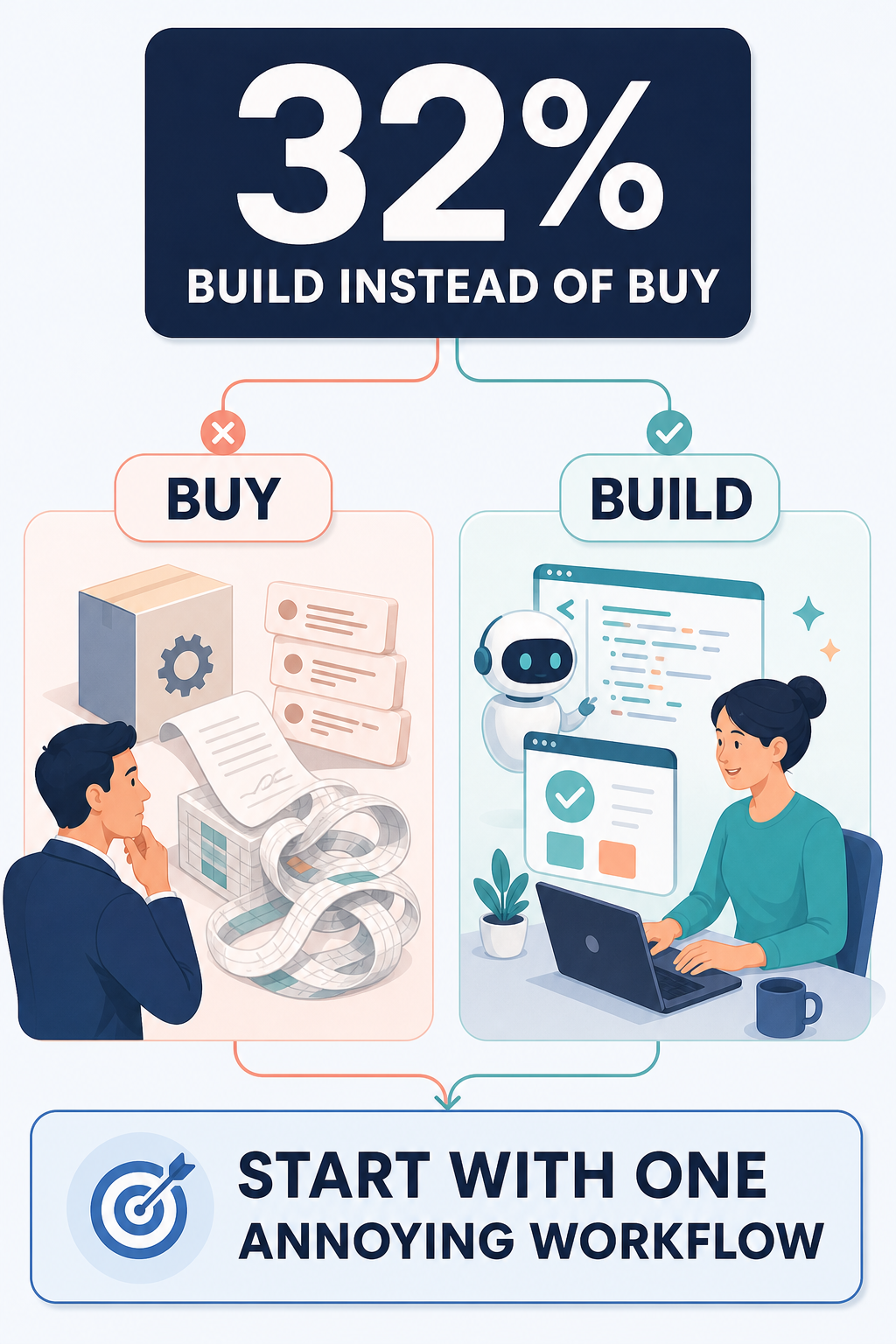
That comes from McKinsey’s new “The State of AI in 2026”. 32% of organizations report they decided against buying software because they could build it internally with AI coding tools. Among tech-sector respondents, it’s 41%. Almost half.
That number wasn’t possible three years ago. Building internal software used to mean a dev team, PMs, and a backlog. Now teams are talking to AI coding agents and iterating from there. The barrier didn’t lower. It is disappearing.
The old model: You need software to fix a problem. You demo it, you buy it, you sign the annual contract. Then you spend the next year bending your workflow around whatever the vendor decided to ship, filing support tickets for the gaps, and building spreadsheet workarounds for the rest.
The new model: You build the tool using AI to fit how you actually work, and you keep changing it as your workflow changes. No annual contract stands between “this is annoying me” and “this is fixed.” No waiting on a product roadmap that isn’t yours.
I pulled my own GitHub history: 3,104 commits since I started building my own AI factory in July of last year, 2,048 of those in just the last 90 days. 82 custom skills, 17 custom agents, 10,146 tracked files, task tracking, a CRM, a content pipeline, and automation that runs my work life. None of it was bought off a shelf.
You can have that same shift McKinsey is describing.
Where to start
You don’t need to rebuild everything.
Pick one piece of software you’re currently bending your workflow around, or one that just hit you with a crazy price increase.
Your first step isn’t “replace it.” It’s smaller.
Open an AI coding agent of your choice—Claude Code, Codex, or Cursor—and describe the one workflow inside that tool that annoys you most: the field you update manually in two places, the report you rebuild by hand every Monday. Ask it to build a small, standalone fix for just that piece. Not the whole CRM. Just the fix.
Keep it low-stakes on the first try. Don’t start with the system that touches customer data or billing. Start with that internal annoyance nobody but you will notice if it’s rough around the edges.
Ship that one thing. See how it feels to own a tool instead of adapting to one. Then decide what’s next.
The 32% didn’t get there by rebuilding their entire stack. They picked one pain point and shipped it.