
Anthropic just deleted 80% of the instructions behind Claude Code. Their own tests showed no measurable drop.
I went and counted what I’ve built up over the past year: 64 skill files, about 90,000 words of instructions. That’s longer than most novels. One skill is 15,000 words by itself. On top of that I have 20 smaller CLAUDE.md files through my vault, each telling Claude how to behave in each folder.
I wrote every word of it on purpose. Tested and revised them multiple times. That approach was right for the older models we had. It’s now working against us.
So I’m rebuilding all 64 skills, and I’m putting my CLAUDE.md on a diet. Everything below applies just as much to a single AI marketing prompt you reuse every week.
The idea comes from Thariq, who works on Claude Code at Anthropic. As the models get better, the winning move is to simplify your instructions. Every rule you write is one more thing Claude has to reconcile against everything else you wrote.
Anthropic’s own transcripts showed the cost. A single request would show up carrying “leave documentation as appropriate” from one file and “DO NOT add comments” from another. Claude untangles it and gets there. But it spends those tokens on you instead of on the work.
I found the same thing in my vault. Pre-trim and post-trim, Opus 5 is 30% better.
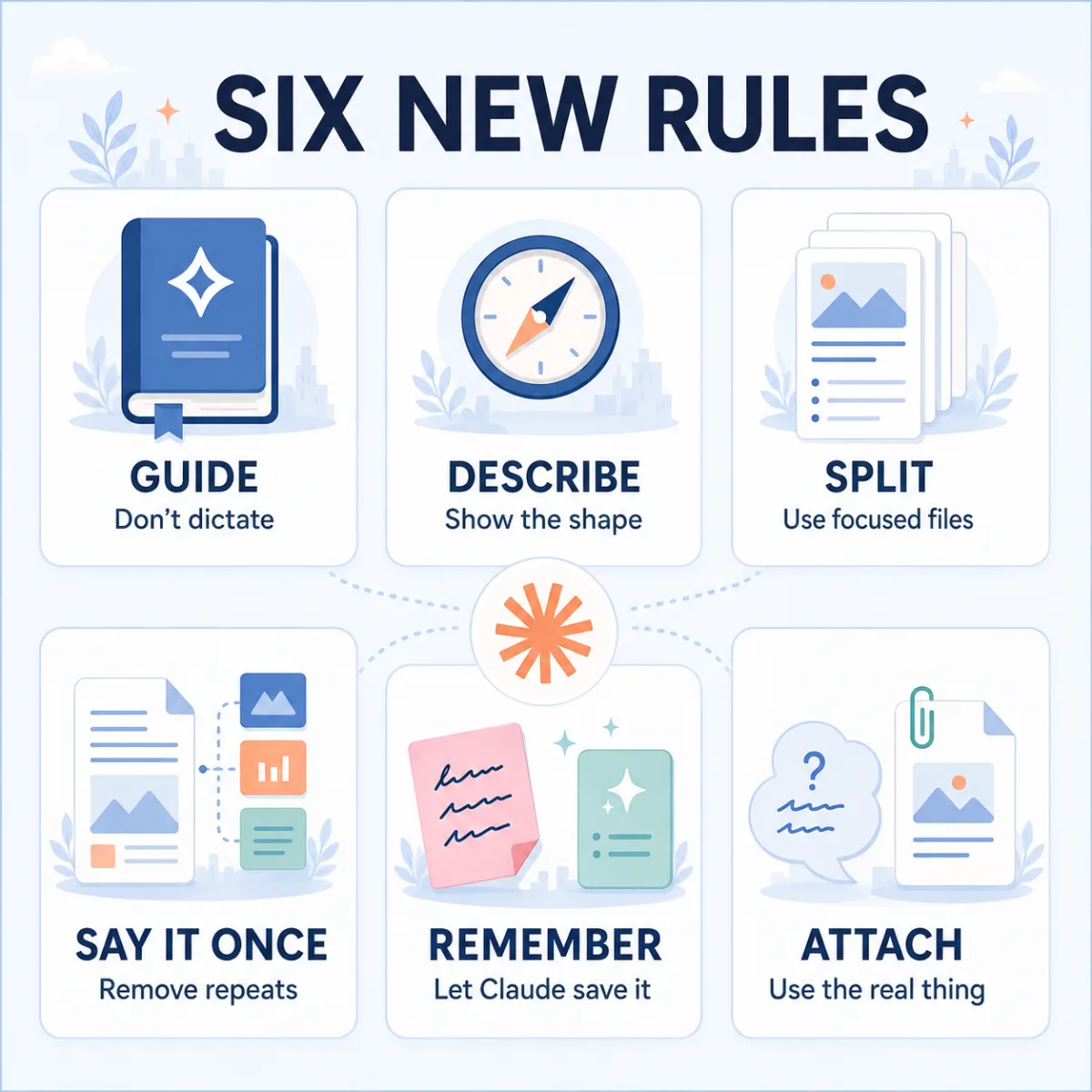
Anthropic’s recommendations
- Replace rules with guidance. Let it use judgment.
- Delete your examples. Describe the shape instead.
- Stop front-loading. Split instructions into files it opens when needed.
- Say it once. Repetition is no longer necessary.
- Stop writing memory by hand. It saves what matters on its own. (I’m testing this)
- Point at real things. A file beats a description of a file.
1. Replace rules with guidance
My brand voice instructions used to read like a contract. Never use em-dashes. Always open with a question. Never say “unlock” or “leverage.” Three sentences per paragraph, maximum.
Every one of those was true most of the time. Not one was true all of the time. And Claude had to reconcile all of them before writing a word.
Anthropic hit the same wall. Their old instructions banned long code comments outright, which was wrong often enough to hurt. Stop writing the rulebook, hand over the standard. Asking Claude to “match the voice in these six emails” carries more than twenty rules about what you forbid, and it survives the cases you didn’t think to write down.
What I cut: 70% of my instructions that I can’t defend in all cases. There are more of them than I’d like to admit.
2. Delete your examples
“Give it examples” was my number one tip to students. I repeated it weekly.
With the newest models, examples fence Claude in. Show it three subject lines you like and you’re quietly burning tokens to cap it at variations of those three. I meant to teach. I was setting a ceiling.
Concisely describe the shape instead. The constraint, the range, the thing that makes an answer wrong.
What I’m cutting: multiple sample outputs I pasted into skills. They stay in one-off prompts, when I want that exact format.
3. Stop front-loading everything
My 15,000 word skill is embarrassing.
I believed a skill had to hold every variation I might ever need, or Claude would never find it. So I kept adding.
Anthropic went the other way. Code review and verification came out of the main instructions and became separate guides Claude opens only when the job calls for it.
Think campaign brief, not brand bible. A short core, then separate files for the parts that only matter sometimes.
What I’m cutting: I was already moving down this path, but now I’ve capped folder instructions at 1,000 words.
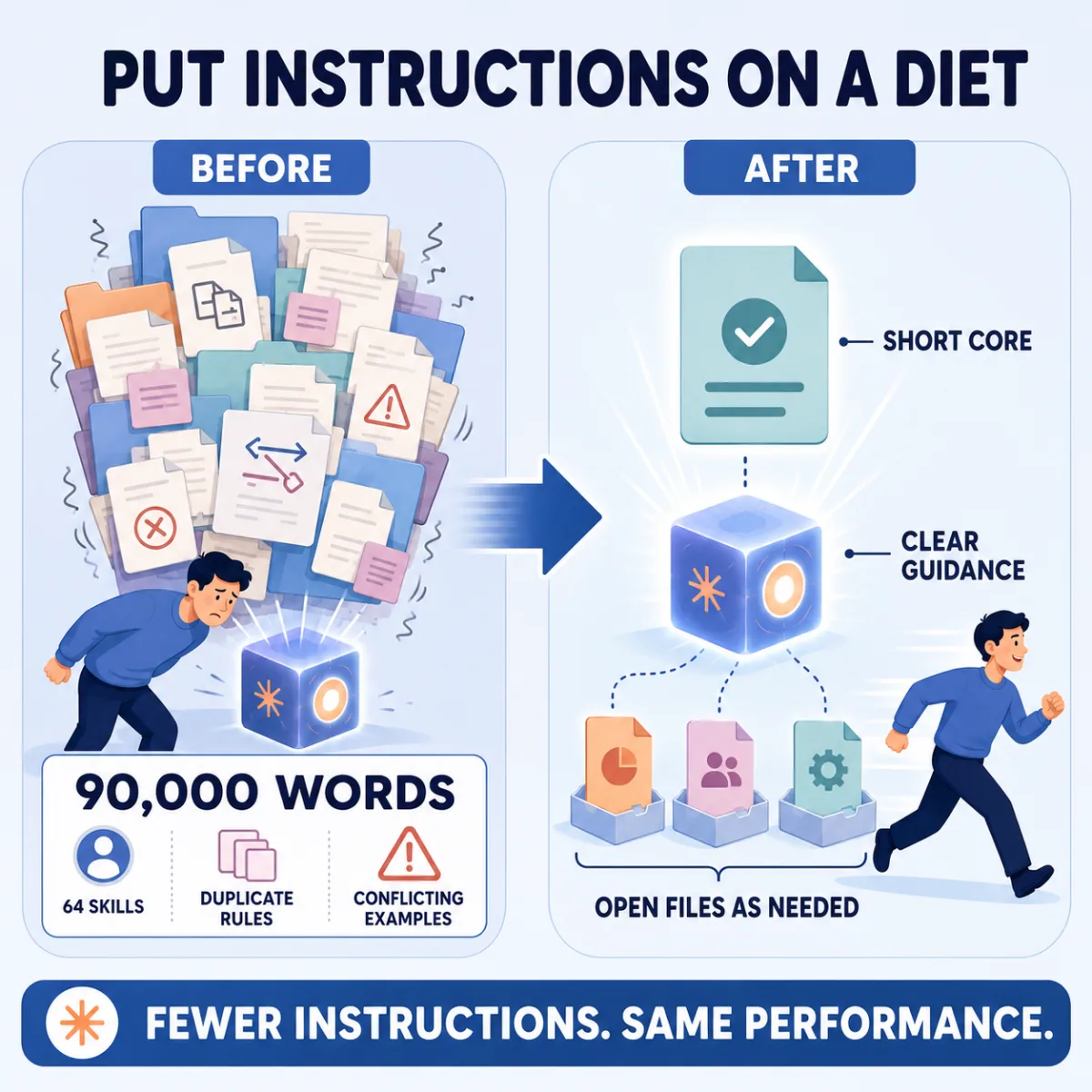
I wrote 90,000 words to make Claude smarter. Most of it was making Claude slower.
4. Say it once
Older models needed telling 2-3 times, and favored whatever sat last. So we repeated ourselves, and the repetition hardened into folklore.
I found the same rule sitting in three of my files today. Three copies, slightly different wording in each. That isn’t redundancy for safety. That’s three chances to contradict myself.
What I’m cutting: every instruction that shows up twice. I keep the copy closest to where the work happens.
5. Stop writing memory by hand
They say Claude now saves what’s relevant on its own. I’m skeptical and still testing this one.
What I’m cutting: the notes buried in my instructions that were really just memory.
6. Point at real things
A description of what you want is weaker than the thing itself.
Anthropic’s example is blunt. A rough HTML mockup of a page beats a written description of that page, and beats a screenshot of it.
Same in marketing. Attach the email that won. The real brief. The spreadsheet with the actual columns in it. Not the summary but the ground truth.
What I’m cutting: summaries, I’ll just attach the document.
Your turn
Open the instructions you lean on most. A Claude Project, your custom instructions, your top skills, the brief you paste into every session.
Read them against those six rules and then decide what to delete. Not edit. Delete. If you use Claude Code, it now ships a /doctor command that does a decent first pass for you.

One caution before you go scorched earth. These findings come from Anthropic’s own testing on Claude Code with the Claude 5 models. Nobody has run the same test on your Claude, or on anyone else’s tools. You need to test what’s actually going to work in your setup, maybe your company has you locked to an older version of Claude.
I’m reworking all of my 64 skills. Trim, run a week of real work through it, measure what actually got worse (so far it’s all been double-digit gains). Better results, fewer tokens.
-Alec