
TL;DR: Skip one and you don’t get an agent, you get more AI slop.
I run agents on Hermes, OpenClaw and Grok Bot. The tool was never the hard part. The hard part is everything underneath it: the goal, the data, the voice, the rules.
Six bots launched or changed in the last 90 days, and a lot of marketers are about to plug one into a mess. Skip a brick and your whole stack leans.
Here’s the tower I wish someone had shown me before I started with AI agents for marketing. Read it bottom-up.
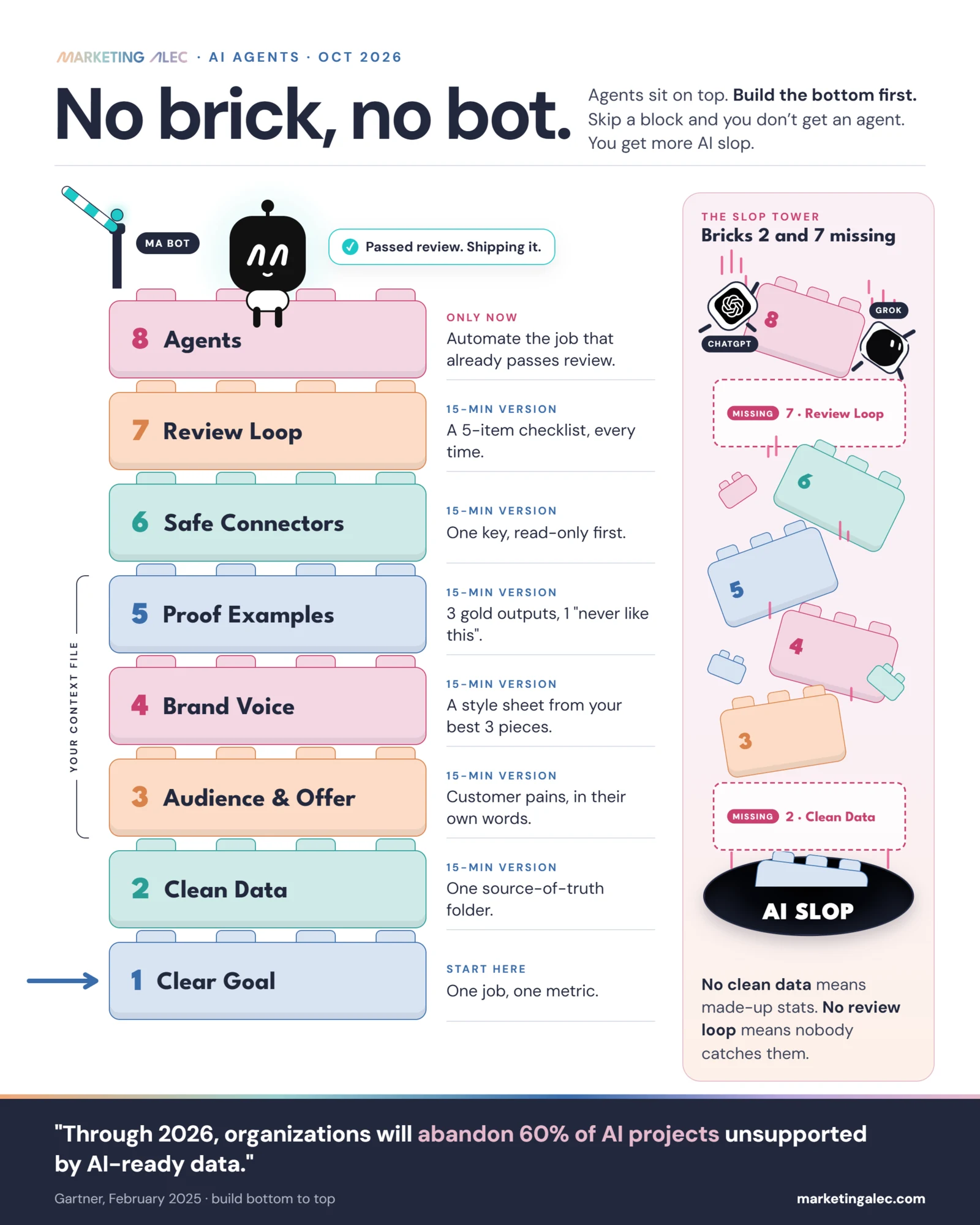
Brick 1: Clear Goal
Pick one boring, repeatable job and one metric. Finish this sentence: “The agent does ___ for ___ so that ___, measured by ___.” If you can’t finish it, rework the idea.
Skip this brick and you get busywork that looks productive, like twelve blog posts nobody reads. A good first job is a weekly metrics recap or a repurposed call transcript. Dull is the point. Dull is reviewable.
Brick 2: Clean Data
Make one folder called source-of-truth/. Put three things in it:
- Your current offer and pricing.
- 90 days of top content, with its metrics.
- A CRM/Data glossary (12 fields max).
Think of handing a new hire a stack of stale binders. They’d get confident and wrong. Agents do the same, at AI speed, with invented stats and old prices.
Gartner (Feb 2025) says it plainly: “Through 2026, organizations will abandon 60% of AI projects unsupported by AI-ready data.”
Salesforce’s State of Marketing found 84% run generic campaigns. Teams with unified data are 60% more likely to use agents. Data is the fuel your agent will run on.
Bricks 3 to 5: Audience, Voice, Proof
These three become your context file. Depending on the bot, that’s CLAUDE.md, Project instructions, AGENTS.md or SOUL.md. You’ll write it once, and the agent loads it every time.
Brick 3, Audience & Offer: customer pains in their own words, pulled from real calls or reviews.
Brick 4, Brand Voice: paste your three best pieces into a chat and ask for a style sheet. Then edit it yourself. The first draft will sound like everyone.
Brick 5, Proof Examples: keep three gold outputs and one labeled “never like this.” Agents copy better than they follow adjectives.
Skip these and you get workslop.
I run a fleet of agents and when they drifted, the cause was almost never the model. It was missing context.
Brick 6: Safety First
One key, not the keyring. I borrowed that line from @distortgeekin’s Grok Bot guide on X, and it’s right. Connect one system, read-only. Then write down what the agent can see and what it can’t touch. Always require your approval for spend, publish, send and delete.
Brick 7: Review Loop
Run it three times with you as the editor. Use a five-item checklist: facts sourced, on-voice, matches the goal metric, no workslop phrases, would I sign my name to it. Every fix becomes a new rule in the context file.
Reviews are the cheapest insurance on the tower. BetterUp and Stanford found 40% of US desk workers received workslop in the past month, at a cost of about $186 per employee per month.
MIT NANDA (Jul 2025) found 95% of organizations get zero return, and blamed a “learning gap” (tools that don’t learn from feedback), not model quality. You can’t fix that for the vendor, but you can for your own AI agent: a loop that turns every fix into a rule is how your agent fleet learns.
Brick 8: Agents (now pick your bot)
At last we get to the Agent. Start with Claude or Grok. They’re the two entry-level bots. Claude runs free or Pro at $20 a month. Grok Bot sits on the $30 X tier.
dots and Muse are a step up. Hermes and OpenClaw are for builders, so leave them until you’re ready to maintain something. Match the bot to where you already work, not to the hype.
Want the agent-by-agent breakdown? That’s Friday’s deep dive. Subscribe and it lands in your inbox.
Do this today
Write the one-sentence goal, then build the source-of-truth/ folder. Do both before you open any bot. That’s fifteen minutes for the sentence and 50X ROI on your future time.
Resources 📚
- If you want the bot-by-bot view → Friday’s deep dive, coming this week (subscribe to get it)
- If you want four starting points ranked by upkeep → A Beginner’s Guide to AI Agents for Marketers